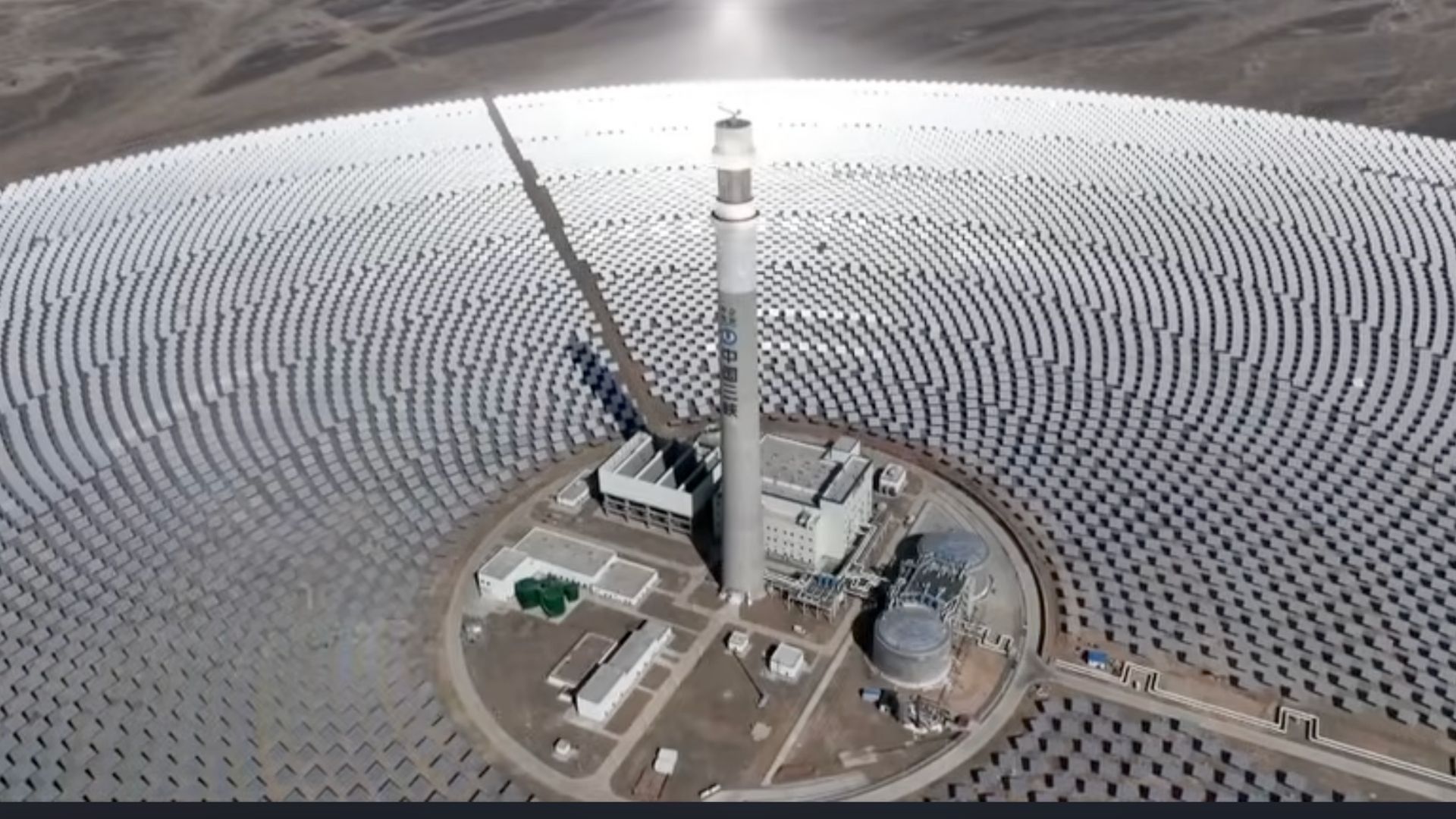
China just connected the world's highest-altitude grid-tied solar-thermal power station to the grid — perched where the air is so thin that construction crews had to design around it.
- Altitude: 4,300 meters (14,100 feet) above sea level
- Total capacity: 150 megawatts (100 MW photovoltaic + 50 MW solar-thermal)
- Expected annual output: approximately 270 million kilowatt-hours
- Projected CO2 avoided: roughly 168,200 tonnes per year once fully operational
The first 25-megawatt generating unit came online on Friday in Gar County, Ngari Prefecture, in China's Xizang autonomous region — the area most of the world knows as Tibet.
How Molten Salt Keeps the Lights on After Dark
The project, developed by China General Nuclear Power Group (CGN), pairs ordinary solar panels with a less common technology: concentrated solar thermal power.
Unlike standard photovoltaic panels, which stop producing the moment the sun sets, this plant uses a photovoltaic-plus-molten-salt-electric-heating design. Surplus daytime electricity heats molten salt, storing that energy as heat until it's needed to drive a steam turbine after dark.
According to the International Energy Agency's SolarPACES program, thermal storage is what makes concentrated solar power "dispatchable" — able to supply electricity during cloudy stretches or overnight, something conventional solar panels alone cannot do.
A separate, even higher 100 MW tower-style plant is also under development nearby in Amdo County, at over 4,650 meters, using 15,927 sun-tracking mirrors, or heliostats, spread across more than 800,000 square meters. That field aims sunlight at a central receiver tower, heating molten salt to roughly 560 degrees Celsius and storing about eight hours of energy for later use.
Building a Power Plant Above 4,000 Meters
Operating at this altitude isn't simple. Builders faced low air density, intense solar radiation, powerful winds, extreme day-to-night temperature swings, and a construction season cut short by harsh winters.
CGN has described its high-altitude solar work more broadly as requiring equipment and methods adapted for oxygen-deficient environments and short build windows — engineering challenges rarely faced by solar projects built at sea level.
The Gar County project also created employment for more than 500 local farmers and herders during construction, according to China Daily.
For remote communities across the Tibetan Plateau, where terrain and winter weather routinely complicate power supply, that kind of round-the-clock reliability could matter as much as the clean-energy angle.
A Bigger Pattern on the Plateau
Neither the Gar nor Amdo facility alone solves the challenge of reliable power across such a vast, high-altitude region. But together they demonstrate a workable template: combine conventional solar generation with thermal storage to smooth out the gap between when the sun shines and when people actually need electricity.
Photovoltaic panels remain cheaper and simpler to deploy at scale, and output still falls whenever sunlight is unavailable. Thermal storage offers one way to shift some of that generation into the hours when it's needed most — a detail that matters far beyond Tibet as more regions try to stretch solar power deeper into the night.
Between them, the Gar and Amdo projects are expected to supply roughly half a billion kilowatt-hours a year once both are fully online — enough to meaningfully offset the diesel and coal generation that has long served the region's scattered towns and herding communities.
With construction crews already working at a second site above 4,650 meters, this is unlikely to be the last altitude record this stretch of the Tibetan Plateau sees broken.


