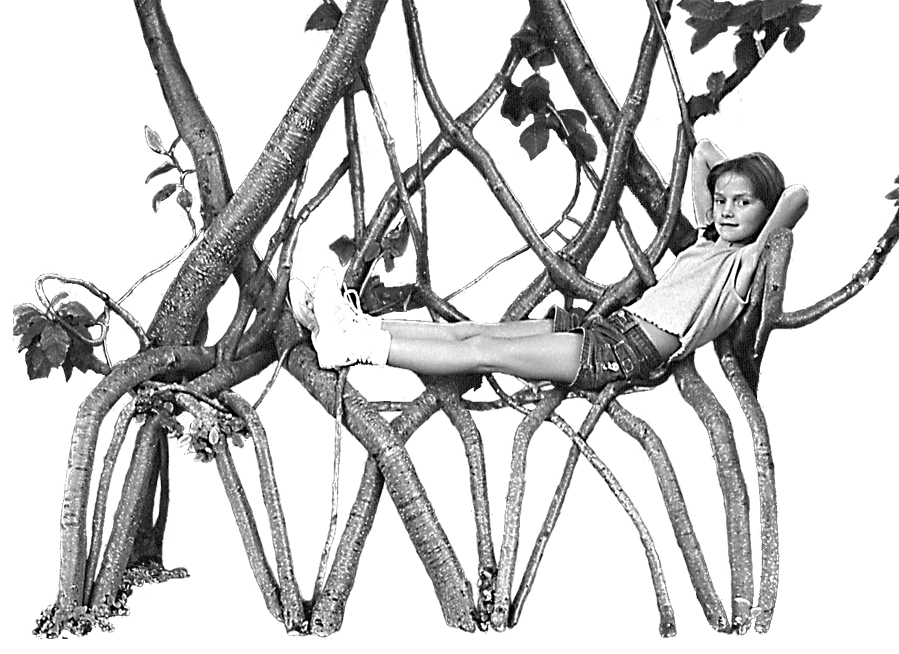
In a quiet field in Derbyshire, England, the chairs are growing in the ground.
How a chair grows instead of being built
Not the wood for chairs. Not the parts of chairs. Actual, finished, ready-to-sit-in chairs, slowly thickening branch by branch around hand-built frames that guide young trees into the exact shape of a piece of furniture. After eight or nine years, the frame comes off, the tree is harvested in a single piece, and a chair walks out of the orchard with no joins, no glue and no screws.
The project — the work of designers Gavin and Alice Munro and their company Full Grown — has been refining the technique for over a decade. This season, they've declared the site Britain's first commercial "furniture orchard", with rows of willow, sycamore, oak, ash and hazel trained into chairs, side tables, lamps and mirror frames.
Growing, not making
The process looks like nothing in conventional carpentry. Each piece begins as a wireframe sculpture of the finished object, built from plastic and wood. Young saplings are planted at carefully chosen points around it, then patiently guided along the frame as they grow. Where two branches meet, they are grafted together so the tree fuses itself into a single woody structure — a centuries-old craft known as inosculation.
Over the years, the frame guides every limb. Stray branches are pruned. Trunks are persuaded into curves. Year by year the chair takes shape, until the underlying wood is thick enough to stand on its own. Then the frame is dismantled, the piece is cut at the base, dried, and finished with oil.
Why no joints means no weak points
Because the wood has grown into the shape rather than being cut to it, the grain runs continuously through the whole object. That is a structural luxury normal furniture cannot match: there are no weak joints, because there are no joints at all.
Slow, on purpose
A Full Grown chair takes about 8 to 10 years from planting to harvest. That sounds like a problem for a business — until you realise the rest of the orchard is full of trees at every stage of growth. A walk through the field shows chairs at year two, year five and year eight at the same time, like a slow-motion factory line that runs on sunlight and rain.
The carbon the tree banks while it waits
While a chair is growing, the tree is doing all the things trees do: pulling carbon out of the air, sheltering insects and birds, building soil, cooling the field around it. By the time a chair is harvested, it has already paid back many times the carbon that conventional furniture spends in milling, shipping and assembly.
A small but serious idea
The orchard will never compete with flat-pack mega-factories — and it isn't trying to. A grown chair is closer to a one-off artwork than a mass-market product, and prices reflect that. But the demonstration is the point.
Britain's first furniture orchard is a working proof that it is possible to "grow what you need" instead of cutting trees down and reassembling them. It's a quietly radical idea: an industry that, instead of consuming forests, gently shapes them.
And on a damp Derbyshire morning, you can already sit in one.