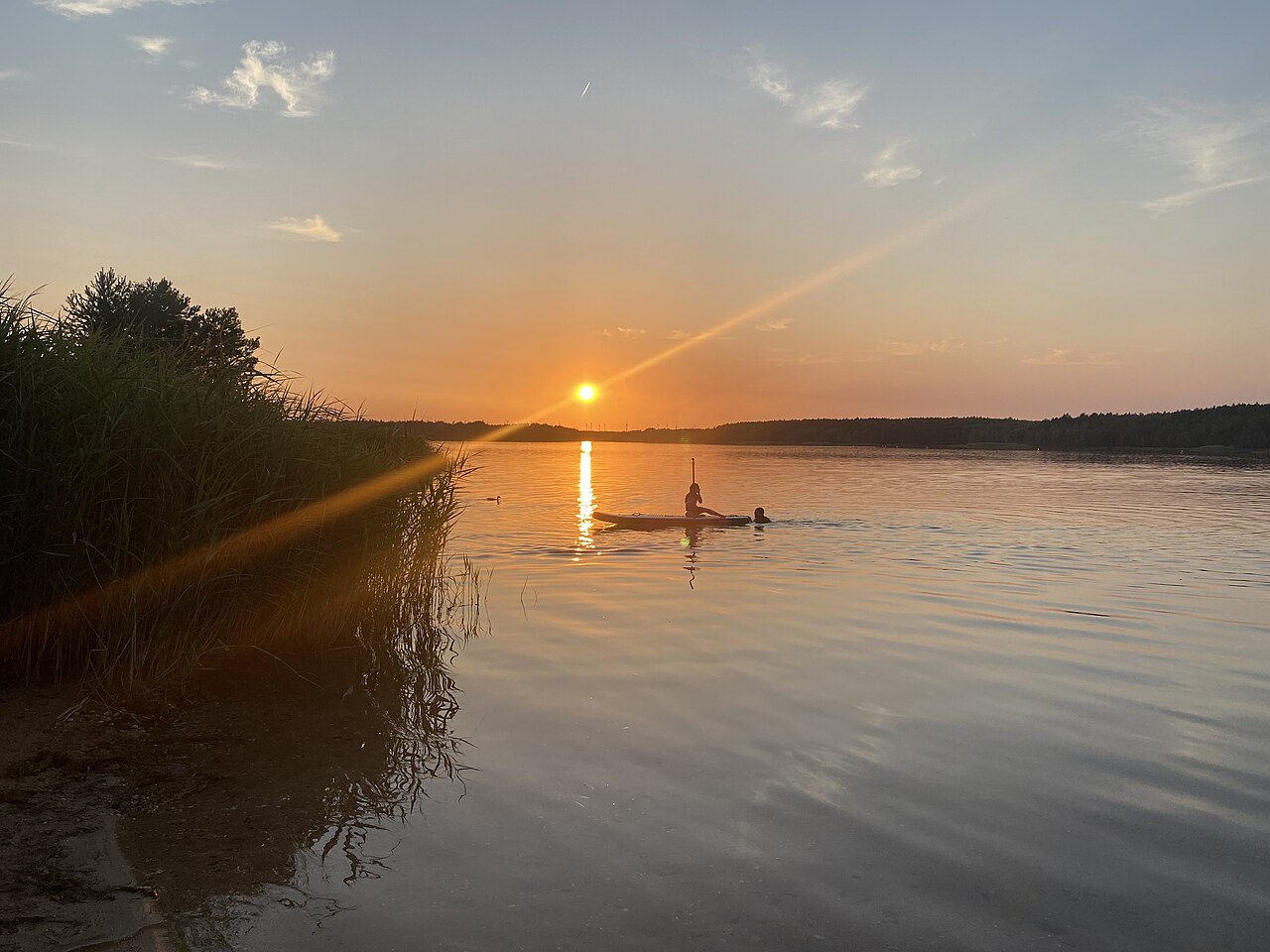
A six-decade engineering project to turn Germany's largest open-cast coal mines into a continuous network of clean swimming and boating lakes is reaching its finish line. At the end of April, Lake Sedlitz — the last of 23 artificial lakes that make up the Lusatian Lakeland — officially opens for recreation, completing what is now Europe's largest human-made water landscape.
The numbers are hard to fathom. The Lusatian Lakeland, which sits between Berlin and Dresden, covers 14,000 hectares of water surface — almost the size of Italy's Lake Como. Ten of the lakes will be linked by 13 navigable canals, six of which are still under construction. When finished, boaters will be able to travel across more than 7,000 hectares of continuous, freshwater shipping lanes. There is even a town in the region called Neu-Seeland, or "New Lakeland," that simply renamed itself when the water arrived.
For most of the twentieth century, Lusatia was one of Europe's most heavily mined regions. East German miners pulled more than two billion tonnes of brown coal — lignite — from depths of 60 meters and below, leaving the land pocked with kilometer-wide craters. After reunification, the German government created a federal company, the Lausitz and Central-German Mining Administration Company (LMBV), to clean up nineteen open-cast areas and quietly start filling them with water.
"This is a process that will take two generations," said the LMBV's Dr. Uwe Steinhuber. The project began in 1967 with the flooding of Lake Senftenberg, decades before the final mines closed. Without active flooding from the Neisse, Spree, and Schwarzer Elster rivers, it would have taken nature 80 to 100 years to fill the craters with rain and groundwater. Engineers compressed that timeline to a few years per lake.
The cost is enormous — roughly 7 billion euros so far in Lusatia alone, with another 4.8 billion expected over the next 25 years. Each long-term, safe lake costs between 200 and 600 million euros to engineer, with 75 percent of the funding coming from the federal government. But the payoff is now visible from space. Satellite images of the region from the 1980s show grey scars on the landscape; today they show a constellation of bright blue lakes ringed by harbors, beaches, and forest.
The Lakeland has also become a regional economic engine. Once-shrinking mining towns now host campsites, sailing schools, and floating restaurants. Cycling routes connect the lakes, and a growing wine industry has taken hold along the southern shores. Locals call the transformation "from black to blue."
Lusatia is not the only post-mining region experimenting with this model. There are 575 lignite-mining lakes scattered across Germany, and dozens more are being created in the years ahead as the country phases out coal. But nothing else is being attempted at this scale — a single, navigable lake landscape created entirely by people, on top of a wound the size of a small country.
For the engineers, scientists, and townspeople who have spent careers on the project, the symbolism matters. "Lusatia would have remained a region almost without lakes," Steinhuber noted; the underlying soil is too sandy to hold standing water naturally. The thing that destroyed the landscape — the mining — is also what made these lakes possible. Sixty years on, Germany has shown what an unfashionable region can become if you give it enough time, money, and patience.


