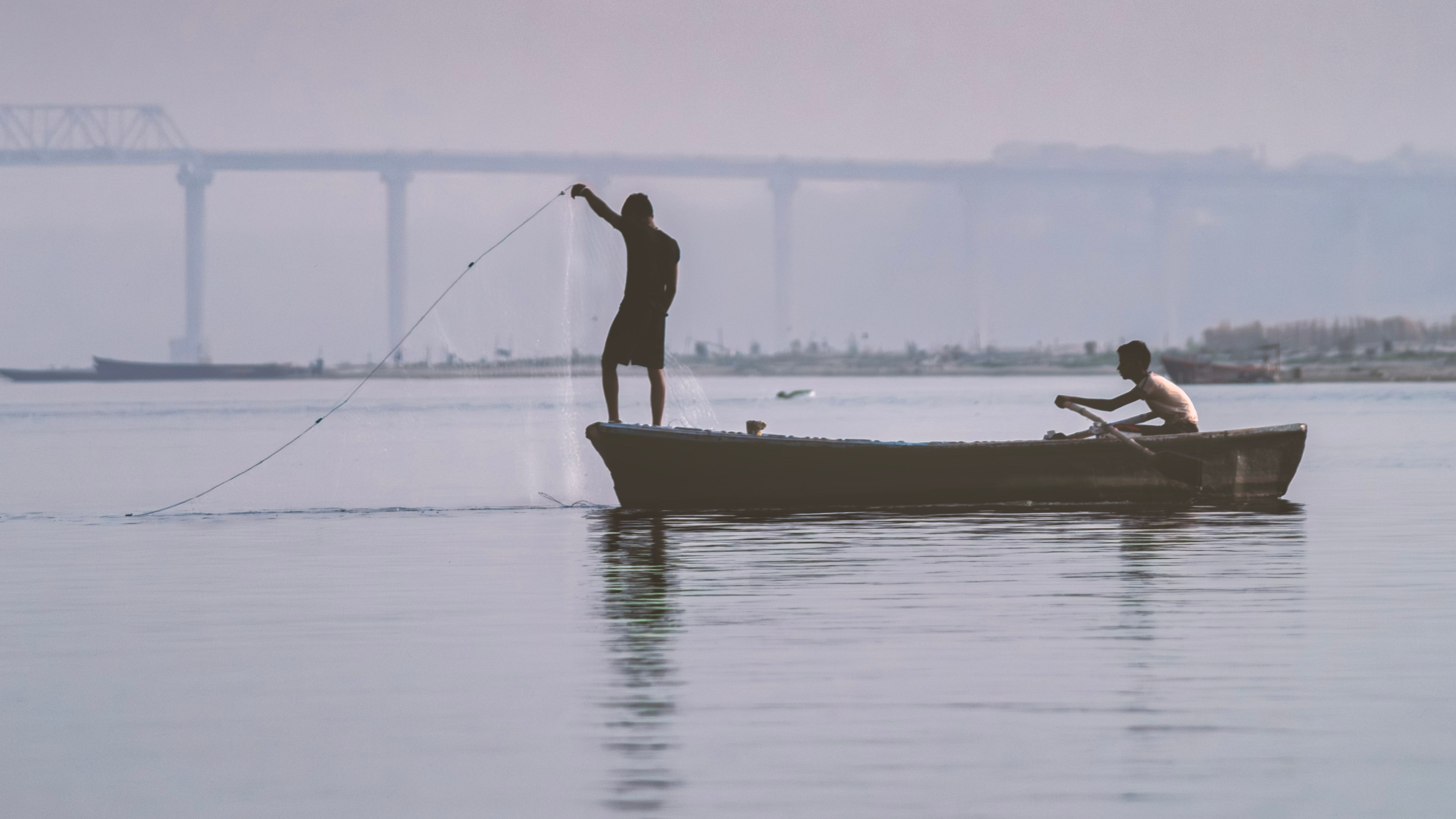
Two fish weighing a combined 740 grams just reappeared in a stretch of India's Ganga river where their species hadn't been seen in roughly five decades.
The hilsa (Tenualosa ilisha) is a migratory fish that once swam from the Bay of Bengal deep into the Ganga system, reaching as far as Varanasi and beyond. That journey was cut off in 1975 when the Farakka Barrage was built, blocking the fish's upstream route and triggering a steep population collapse in the river's middle and upper stretches.
- 740 grams — combined weight of the two hilsa recently recorded near Tanda Khurd village, Uttar Pradesh
- 385,000+ juvenile and adult hilsa released upstream of the barrage since 2019
- 4 million+ fertilized eggs released as part of the restoration effort
- 940,000 hatchery-produced hilsa spawn, aged 2–6 days, also released
- 1975–2026 — roughly 50 years the species was largely absent from the upper river
A fish that disappeared, then a plan to bring it back
Hilsa is more than a food fish in the region — it carries ecological, nutritional and cultural weight, and its disappearance hit riverine fishing communities whose livelihoods depended on it. Recognizing that, ICAR's Central Inland Fisheries Research Institute (CIFRI) in Barrackpore teamed up with the National Mission for Clean Ganga (NMCG) to launch a long-term scientific restoration program.
The approach went beyond simply dumping fish into the water. Scientists combined river ranching, stock enhancement, artificial breeding, and the release of fertilized eggs and hatchery-produced spawn, then tagged and tracked released fish to understand how — and whether — they migrated.
What the tagging data showed
Between 2023 and 2025, monitoring had already recorded ranched hilsa swimming as far upstream as Mirzapur, an early sign the restoration was working before the recent Tanda Khurd sighting confirmed it. The newest appearance, near the Markandey Mahadev Temple in Chandauli district, is the clearest field evidence yet that the species is reclaiming part of its historical range.
Because hilsa is a sensitive migratory species, its presence functions as a kind of biological report card for the river itself — a signal that connectivity and water quality in that stretch have improved enough to support its journey.
The return of hilsa offers hope for restoring other native and migratory aquatic species and reinforces the principle that rivers should be managed as living ecosystems rather than merely as channels for water management, according to ICAR-CIFRI.
Why a two-fish sighting is a big deal
It's easy to undersell a story about two fish. But rebuilding a disrupted migratory pathway for a species that travels hundreds of kilometers from a river delta to interior freshwater stretches is a slow, data-heavy process — closer to rebuilding a highway than planting a tree. The payoff shows up gradually, one confirmed sighting at a time, often years after the interventions began.
Officials from the ICAR-CIFRI and NMCG partnership describe the project as proof that sustained scientific effort, institutional follow-through and community cooperation can bring back a species considered locally lost. For the fishing communities along the upper Ganga whose livelihoods once depended on hilsa season, that's a tangible reason for cautious optimism.
Full details on the restoration program are available from ICAR and Deccan Herald.


