One of the most stubborn mysteries in battery science has finally been solved.
For years, engineers developing solid-state batteries have been stymied by a puzzling failure mode: soft lithium dendrites — tiny tree-like structures that grow from the battery anode during charging — somehow manage to penetrate and crack solid ceramic electrolytes, causing short circuits and battery failure. Lithium metal is about as soft as a gummy bear. The ceramics in question are orders of magnitude harder. How does the soft substance destroy the hard one?
Now, a team at the Max Planck Institute for Sustainable Materials (MPI-SusMat) has answered that question with precision, publishing their findings in the journal Nature.
The Mechanics of Failure
How the dendrites actually crack the ceramic
Led by Dr. Yuwei Zhang, the group studied a solid electrolyte called lithium lanthanum zirconate, using an advanced combination of materials characterization techniques — all performed under vacuum and at cryogenic temperatures to prevent contamination from oxygen, water, or even electron beams.
Their analysis revealed the mechanism: hydrostatic stress builds up inside the growing dendrite as it penetrates the ceramic electrolyte. That pressure acts like a continuous waterjet boring through rock — sustained, directional force that eventually causes the hard ceramic to fracture in a brittle failure.
"The soft lithium metal is able to penetrate the stiff ceramic electrolyte, like a continuous waterjet that penetrates a rock," said Zhang.
Crucially, the team ruled out a competing hypothesis — that lithium nuclei form ahead of the dendrite tip and interconnect to form a conductive path. Detailed measurements showed no such buildup. The fracture is driven by mechanical stress, not by electron migration.
What This Means for EVs and Phones
Why this matters for EVs and phones
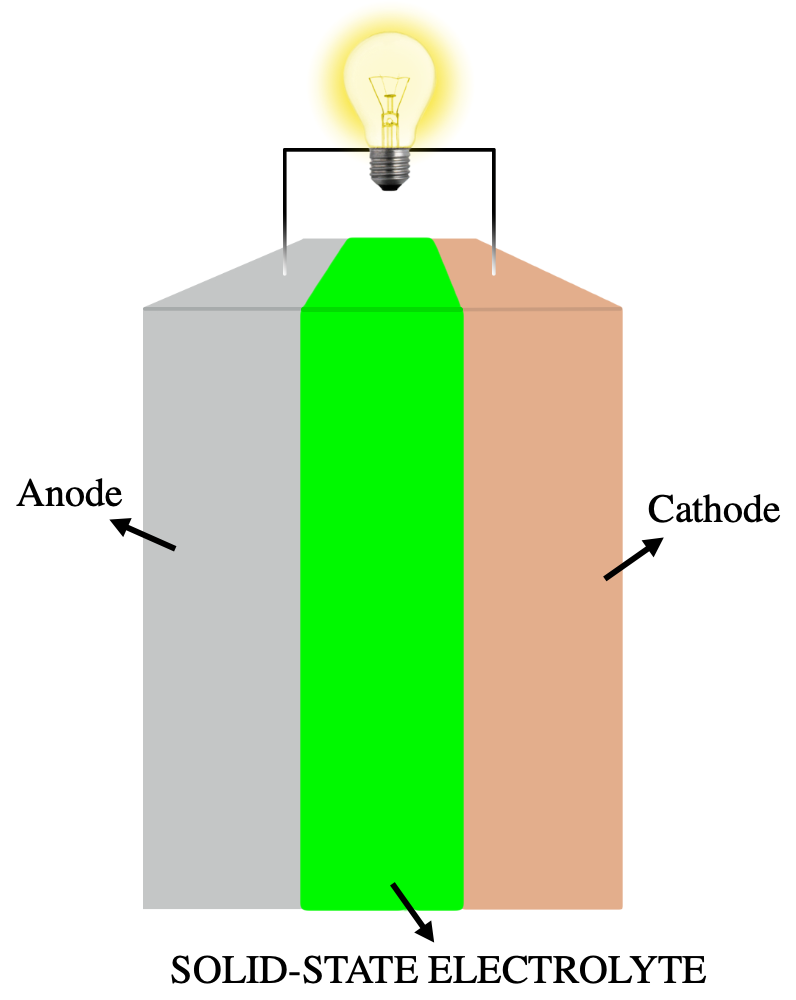
Solid-state batteries are considered the next major leap in energy storage. Unlike conventional lithium-ion batteries — which use a liquid electrolyte that can leak, catch fire, or degrade — solid-state designs use a solid electrolyte with clear advantages: higher energy density, longer lifespans, and far better safety.
In electric vehicles, those advantages would translate to driving ranges potentially three times greater than today's leading models. For smartphones and laptops, solid-state batteries could mean multiple days of use on a single charge.
The problem has been durability. Dendrite formation under repeated charging causes solid electrolytes to crack and fail, limiting the technology's commercial viability. No automaker has deployed a true solid-state battery at scale, and timelines to market have slipped repeatedly as the dendrite problem persisted.
Understanding the exact mechanism of failure is the necessary precursor to solving it. The MPI-SusMat team is now investigating three potential strategies: making the electrolyte tougher to resist cracking, introducing microscopic voids that redirect crack propagation away from vulnerable areas, and adding protective coatings to the lithium anode.
A Field-Opening Discovery
"Although the electrodes and the forming dendrites consist of lithium metal, which is soft like a gummy bear, the dendrites are able to penetrate the ceramic electrolyte and lead to a short circuit," Zhang said. "We calculated that hydrostatic stress in the dendrite leads to brittle fracture of the solid electrolyte in the end."
The road from discovery to a fix
The publication in Nature marks a significant milestone. For consumers, engineers, and the climate, it is precisely the kind of breakthrough the energy transition has been waiting for. Safer, longer-lasting batteries aren't just a market opportunity — they're an essential part of the shift away from fossil fuels. With the mystery of lithium dendrite failure now solved, the engineers building tomorrow's batteries have a clearer roadmap than they've ever had.


