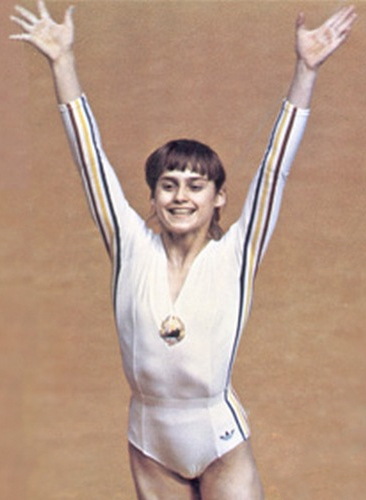
Half a century after a 14-year-old from a small Romanian town rewrote what was possible on a gymnastics floor, Nadia Comăneci stepped onto a stage in Madrid on Monday night and was handed the Laureus Lifetime Achievement Award.
The Laureus World Sports Awards — often described as the Oscars of global sport — gathered Carlos Alcaraz, Aryna Sabalenka, Chloe Kim and a room full of Olympians, but the loudest and longest ovation went to the woman who did something no one had ever seen before.
At the 1976 Montreal Olympics, Comăneci performed a routine on the uneven bars that was so flawless the scoreboard could not display what she had earned. The machinery had been built assuming a Perfect 10 was impossible, so when the judges delivered one it lit up as "1.00". She went on to collect seven Perfect 10s in Montreal, three gold medals, and a place in sporting history that has never been matched in quite the same way.
"Receiving this award is one of the greatest honors of my life," Comăneci told the audience during her acceptance speech. She spoke about the generations of gymnasts who have followed her, many of whom were sitting in the room, and about how much the sport has grown since she first stepped onto an Olympic mat as a teenager.
The Laureus World Sports Academy, which selects the winners, called her a figure who "redefined excellence" and whose influence still shapes the sport. Fellow academy members who presented the award described her as the athlete who made gymnastics a global spectacle overnight. Television ratings for the 1976 Games soared after her first Perfect 10, and a generation of girls signed up for gymnastics classes in the weeks that followed.
Comăneci's career extended far beyond Montreal. She won two more golds at the 1980 Moscow Olympics and became one of the most recognized athletes on the planet. After emigrating to the United States in 1989, she continued to work in the sport through coaching, commentary and philanthropy. Together with her husband, Olympic gymnast Bart Conner, she has run gymnastics academies, a publication for the sport, and charitable foundations supporting children's sports access and medical care in Romania.
The Lifetime Achievement Award places her alongside previous recipients who include Pelé, Muhammad Ali, Billie Jean King and Roger Federer. For the Laureus Academy to select a gymnast for this honor underlines how fully Comăneci changed the way the world views her discipline.
The timing of the award — exactly 50 years after Montreal — gave the evening a celebratory weight. Clips of the 1976 routines played on screens around the ballroom. Many in the audience had watched those performances live on television as children. Others, younger athletes, described her in interviews afterward as the reason they took up the sport at all.
Romania has seen a renewed burst of national pride in the days since. The country's president issued a statement calling her "a symbol of Romanian excellence." Social media filled with photos of young gymnasts in local clubs re-enacting the famous bars routine, and the Romanian Olympic Committee announced plans for a national celebration in Bucharest later this year.
For Comăneci herself, the moment in Madrid seemed less like a finish line than a thank-you. "I was just a girl who loved gymnastics," she said. "I never imagined any of this."
Fifty years on, the world is still watching — and still smiling.


