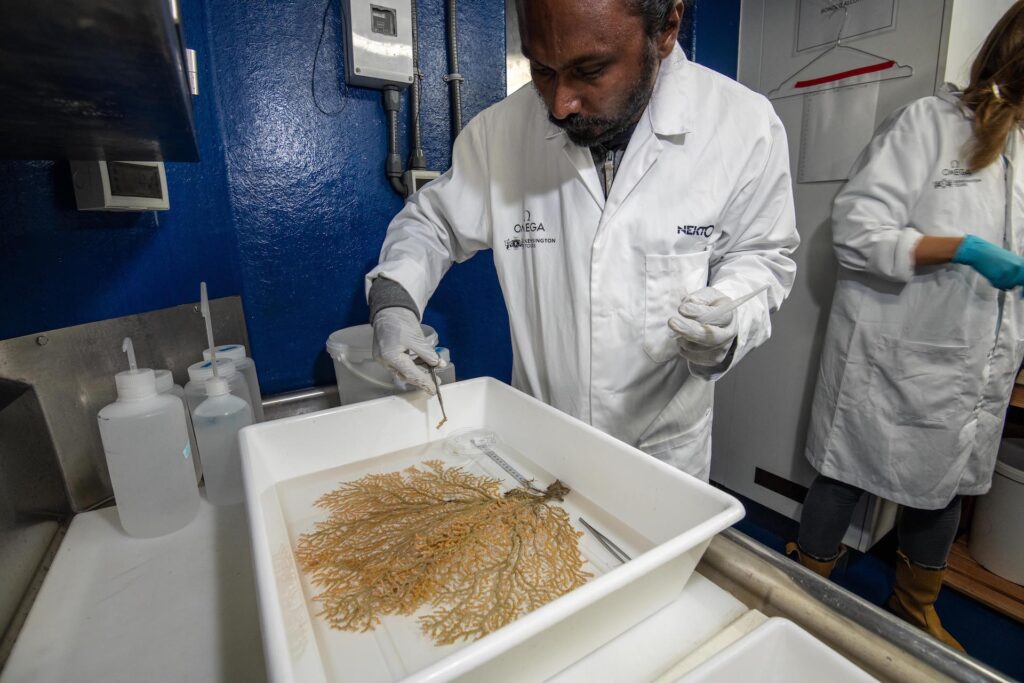
A ghost shark that predates the dinosaurs. A worm that lives inside a "glass castle." A shrimp hiding in a sea cave off Marseille. In just twelve months, marine scientists catalogued all of them — and over a thousand more creatures never recorded before.
- 1,121 new marine species discovered in a single year
- 54% increase over the normal annual global identification rate
- 13 expeditions and 9 species discovery workshops worldwide
- 6,575 metres — the depth of the deepest new find
- 90% of ocean species are still estimated to be undocumented
A bottleneck finally breaking
The discoveries come from Ocean Census, a Nippon Foundation–Nekton initiative billed as the world's largest mission to accelerate ocean species discovery. Between April 2025 and March 2026, its scientists ran expeditions from the Coral Sea to volcanic seamounts off Japan, working with partners including CSIRO, JAMSTEC and the Schmidt Ocean Institute.
Historically, the gap between finding a new species and formally describing it in scientific literature has averaged 13.5 years — long enough for many species to vanish before anyone even names them. Ocean Census built a new open-access platform, NOVA, specifically to close that gap by publishing verified discoveries within weeks.
"With many species at risk of disappearing before they are even documented, we are in a race against time to understand and protect ocean life," said Dr. Michelle Taylor, Head of Science at Ocean Census.
What the expeditions found
The species spotlighted in this year's results read like a field guide to the ocean's strangest corners. A newly identified "ghost shark" chimaera — a distant shark and ray relative whose lineage split off nearly 400 million years ago — turned up in the Coral Sea Marine Park off Queensland, found by CSIRO taxonomist Dr William White.
Off a volcanic seamount in Japan, researchers discovered a polychaete worm that makes its home inside the crystalline silica chambers of a glass sponge — a find so distinctive it was published in The Zoological Journal of the Linnean Society. Off Marseille, a shrimp with vivid orange banding turned out to be new to science too, proof that discoveries are still possible along Europe's busiest coastlines, not just in remote trenches.
"We spend billions searching for life on Mars or going to the dark side of the moon. Discovering the majority of life on our own planet — in our own ocean — costs a fraction of that." — Oliver Steeds, Director of Ocean Census
Why it matters beyond the lab
The data feeds directly into international policy. Ocean Census says its findings support the High Seas "Biodiversity Beyond National Jurisdiction" Treaty and the Kunming-Montreal Global Biodiversity Framework — the kind of hard evidence that regulators need before they can justify protecting a reef or a seamount that most people will never see.
More than 1,400 taxonomists and scientists across 660 institutions and 85 countries now contribute to the network. Ocean Census's co-founder, Nekton, is seeking $100 million in catalytic capital to scale the effort toward an ambitious long-term goal: discovering 100,000 new marine species.
For now, the 1,121 new names added this year are a reminder of how much life remains hidden in plain sight, just below the surface of the water most of us have looked at a thousand times without ever wondering what's underneath.


