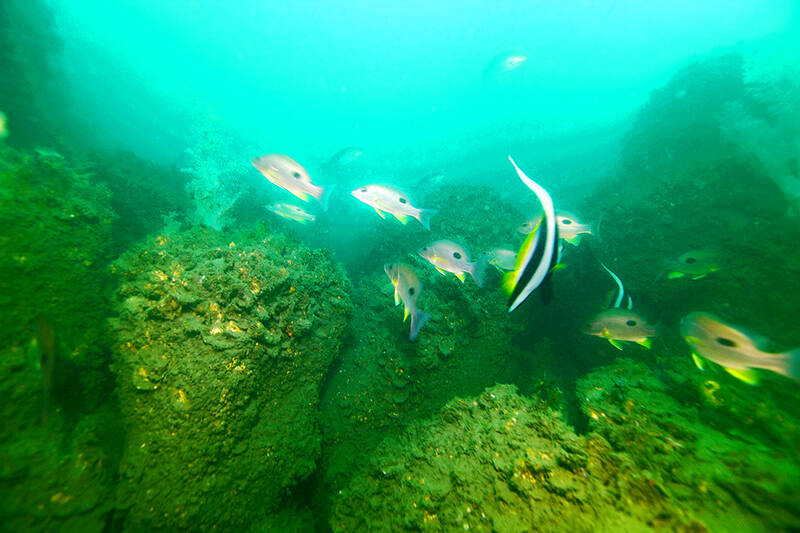
Steel built to hold up wind turbines is quietly becoming some of the richest fish habitat on two different coastlines. Divers have now logged more than 11,500 individual fish around turbine foundations off Taiwan alone — while a brand-new reef is forming thousands of miles away off New York.
- 97 fish species recorded on turbine foundations off Taiwan's coast
- 11,500+ individual fish counted across repeated dive surveys
- 54 steel foundations off New York's Long Island are building a matching reef
- 330 feet — the radius of new reef habitat measured around each New York foundation
An accidental reef off Taiwan
A research team from National Taiwan Ocean University's Institute of Marine Biology, led by professors Shao Kwang-tsao and Shao Yi-ta, spent years diving and running pole-and-line surveys around wind farms off Miaoli and Changhua counties. What they found surprised even the researchers: the submerged base of each turbine works like a vertical artificial reef, drawing fish from the surface, middle, and bottom layers of the water column all at once.
Within months of a turbine's construction, barnacles, sponges, and corals colonize the steel, creating habitat for shrimp, crabs, and worms — which in turn attract high-value species like groupers, snappers, and lobsters looking to feed or lay eggs. According to peer-reviewed findings published in Frontiers in Marine Science, these structures now support meaningfully more fish species than the sandy seabed ever did, without displacing the bottom-dwelling species that lived there before.
"Vertical structures of turbine foundations extend from the surface to the bottom of the ocean, providing hard substrate surfaces, while also functioning as upright artificial reefs." — National Taiwan Ocean University research team, via Taipei Times
New York's reef nobody designed
A similar story is unfolding off Long Island, where crews drove 54 steel foundations into bare Atlantic sand for a US offshore wind project. Engineers weren't trying to build fish habitat — they were anchoring turbines. But the rock armor placed around each foundation to prevent erosion has become exactly that: new research now measures a roughly 330-foot radius of reef-associated marine life around every single foundation.
That means 54 new patches of hard-bottom habitat now dot a stretch of ocean floor that used to be featureless sand — an unplanned side effect that's turning out to be good news for local marine life.
Wind power's unplanned upside
Neither research team set out to study conservation; both were investigating how offshore wind interacts with existing fisheries and ecosystems. The Taiwanese researchers are now calling for more comprehensive fishery management rules to help offshore wind farms formally support marine conservation goals, rather than treating the reef effect as an accident to be managed around.
As more turbines go up off both coasts in the coming years, the fish moving in appear to have made their verdict clear: given hard structure and time, the ocean floor around a wind farm doesn't stay empty for long.