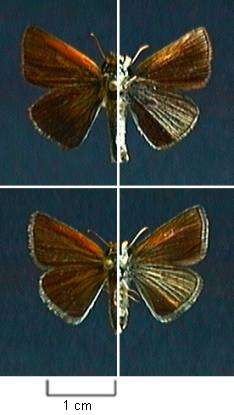
In 2022, researchers combing the last known prairies for the Poweshiek skipperling found fewer than 9 butterflies in the entire wild population — the lowest count ever recorded for the species. Three years later, zoos are releasing more than a thousand a year back into the wild.
- 9 Poweshiek skipperlings counted in the wild in 2022, an all-time low
- 1,300+ zoo-raised butterflies released into restored prairies in 2025
- 32 adults the John Ball Zoo captive-breeding program started with
- 22% drop in overall butterfly populations over the past 20 years, the backdrop this recovery bucks
Down to nine, then back from the brink
The Poweshiek skipperling is barely an inch long, brown and orange, and named for Poweshiek County, Iowa, itself named after a Meskwaki chief. It once ranged across unplowed prairies in eight U.S. states and one Canadian province.
By the time it was listed as endangered in 2014, the butterfly had vanished from nearly its entire historic range. Only one Michigan county and a single Manitoba prairie still held wild populations. Then came the 2022 count: fewer than 10 individuals, anywhere.
Three institutions — the Minnesota Zoo, Winnipeg's Assiniboine Park Zoo, and Michigan's John Ball Zoo — had already been quietly building captive-breeding colonies. Michigan State University researchers joined the effort, working with federal and state wildlife agencies to figure out how to breed a notoriously finicky species and get it back into the wild.
How three zoos rebuilt a population from scratch
Breeding Poweshieks in captivity is not simple. Pairing and encouraging adults to mate takes a practiced hand, but once a colony takes hold, it multiplies fast, free of the predators and pesticides that hammer wild populations. John Ball Zoo's program started with just 32 adults.
"Our work is to preserve, restore, and recover the species that have been in rapid decline," Nick Haddad, a Michigan State University integrative biology professor at the Kellogg Biological Station, told Michigan Public Radio. "As areas are restored where they used to be, we can release them back out."
For the first time in decades, wild Poweshiek skipperling populations in both the U.S. and Canada are now larger than the captive population.
Releases climbed fast: about 500 butterflies in 2024, then more than 1,300 in 2025, each marked with a tiny colored dot so scientists can track survival. One 2026 release site in Michigan marked the species' return to ground where it had completely disappeared, the first time that had been done in the U.S., according to the U.S. Fish and Wildlife Service.
Why the habitat matters as much as the butterfly
Poweshieks need "prairie fens," rare wet grasslands that also happen to filter water and control flooding for nearby communities. Researchers believe pesticide runoff in those fens, more than habitat loss alone, likely drove the population's collapse, according to Michigan State University's reporting.
The species isn't safe yet. It remains critically endangered and survives on only a handful of managed sites, and the vast majority of its former range remains empty. But conservationists now want to apply the same captive-breeding playbook to the Mitchell's satyr, another struggling Midwestern butterfly, and reduced pesticide use across prairie fens more broadly, hoping this fingertip-sized comeback becomes a template rather than an exception.


