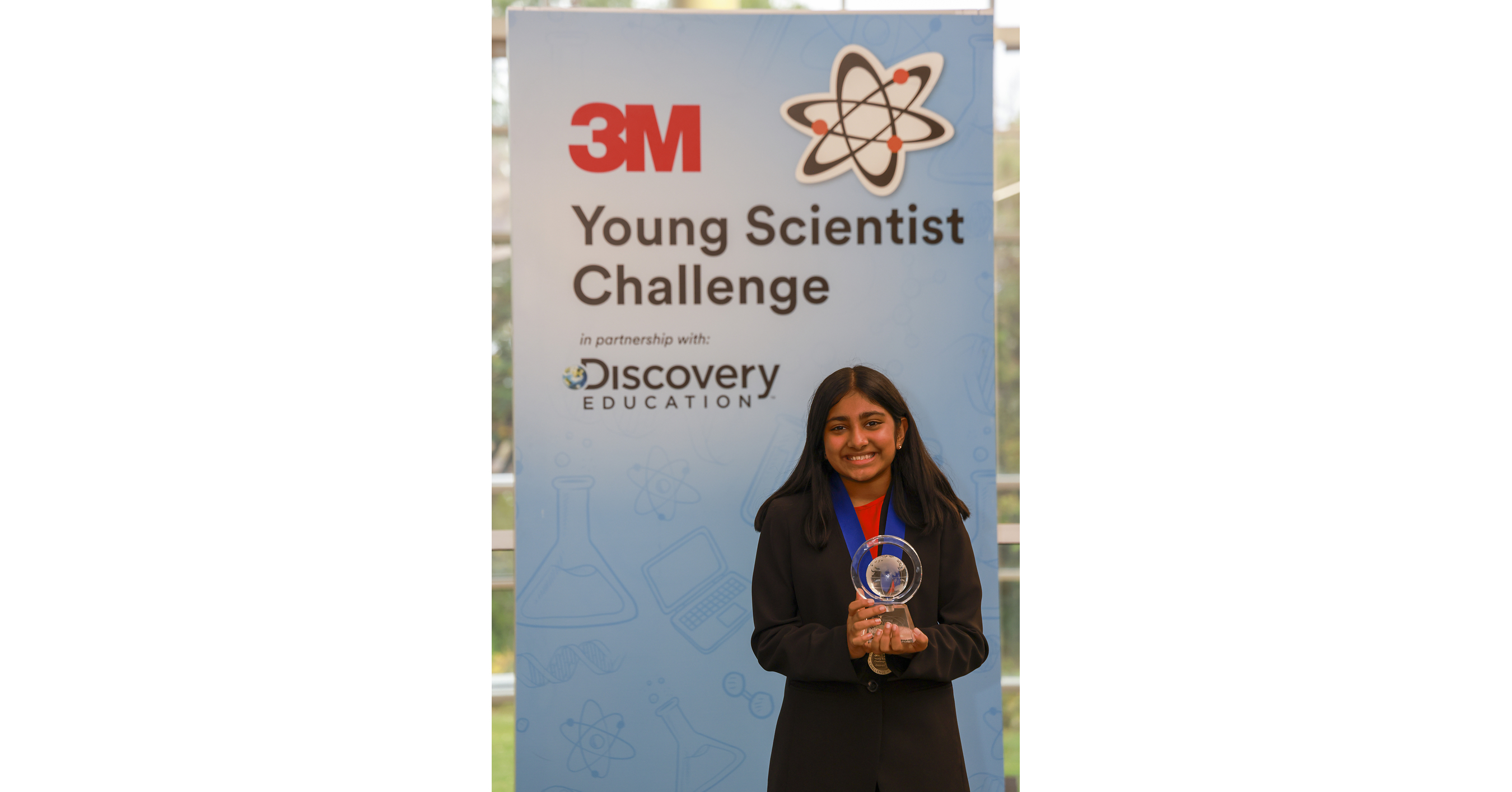
Raji Doshi collects seashells for fun. This year, worrying about what was happening to them won her $25,000 and the title of America's Top Young Scientist.
- 13 years old: Raji's age when she won
- $25,000 cash prize for first place
- 10 finalists competed, ages 11 to 14
- 2026 marks this year's edition of the nation's top middle-school science competition
A seashell problem she couldn't ignore
On October 14, 2026, 3M and Discovery Education announced Raji, an eighth grader from Farmington, Connecticut, as the winner of the 2026 3M Young Scientist Challenge. She attends Stanford Online High School and competed against nine other finalists over the summer, with the final events held at 3M's global headquarters in St. Paul, Minnesota.
Her project started with a hobby. Raji collects seashells, and she grew troubled learning that rising ocean acidity — caused as seawater absorbs more carbon dioxide from the atmosphere — was weakening the shells and skeletons of marine organisms around the world. That concern turned into an invention she named ALKACORE.
How ALKACORE works
Raji's entry, titled Engineering a Novel Durable Algae-Aragonite Alkalinity System to Reduce CO2-Driven Ocean Acidification, pairs cultivated macroalgae with aragonite, a natural form of calcium carbonate that acts as a chemical buffer. The goal is a durable, low-cost way to cut acidification at the coastal level, where local interventions could realistically be deployed.
Through carbonate chemistry analysis, Raji showed that adding aragonite increased algae biomass, pulled carbon dioxide out of the system, and meaningfully lowered dissolved CO2 in seawater samples. She went a step further than a lab demonstration by building a computational model based on Michaelis-Menten kinetics to calculate the optimal aragonite dose — turning a classroom project into something closer to a deployable engineering tool.
That combination is what set her entry apart from a typical science-fair build. Ocean acidification is usually described as a slow, planet-scale problem with no obvious local lever to pull. Raji's system instead targets a specific, measurable stretch of coastal water, pairing a living organism (the algae) with a mineral buffer (the aragonite) in a ratio her model could actually optimize rather than guess at.
"Raji's project reminds us that when you're passionate about something, you can use that interest to change the world," said Deborah Isabelle, Raji's 3M mentor and a product engineering specialist, according to PRNewswire.
A pipeline built for ideas like hers
Every 3M Young Scientist Challenge finalist is paired one-on-one with a 3M scientist for months of mentorship, carrying an idea from a rough concept to a working prototype. Judges evaluated creativity, scientific knowledge, communication, ingenuity, application of STEM principles, and research quality.
Two other finalists also took home recognition: Aaisha Asif, a seventh grader from Sarasota, Florida, placed second, and Sharvi Mahajan, a ninth grader from San Diego, California, placed third, each earning $1,000 prizes.
For Raji, the win caps a project that began with a simple attachment to something small and overlooked. Ocean acidification is typically discussed in terms of entire ecosystems and global carbon budgets; her entry point was a lot more personal — the shells in her own collection — and it carried her all the way to a national stage built specifically to take middle schoolers' ideas seriously.
The 3M Young Scientist Challenge has run for close to two decades specifically to catch ideas like hers early, before a young inventor has access to a university lab or a research budget. Raji's prize money and national title now give ALKACORE something most middle-school projects never get: a credible next step, backed by a model, a mentor relationship with 3M, and public validation that a coastal-water fix for acidification is worth taking seriously well beyond a science fair gym.
Her own framing of the project stayed modest throughout the competition — she has said she simply wanted to solve a real-world problem, not win a trophy. The trophy came anyway, glass and all, for a 13-year-old who looked at her own seashell collection and decided the ocean chemistry behind it was worth fighting for.