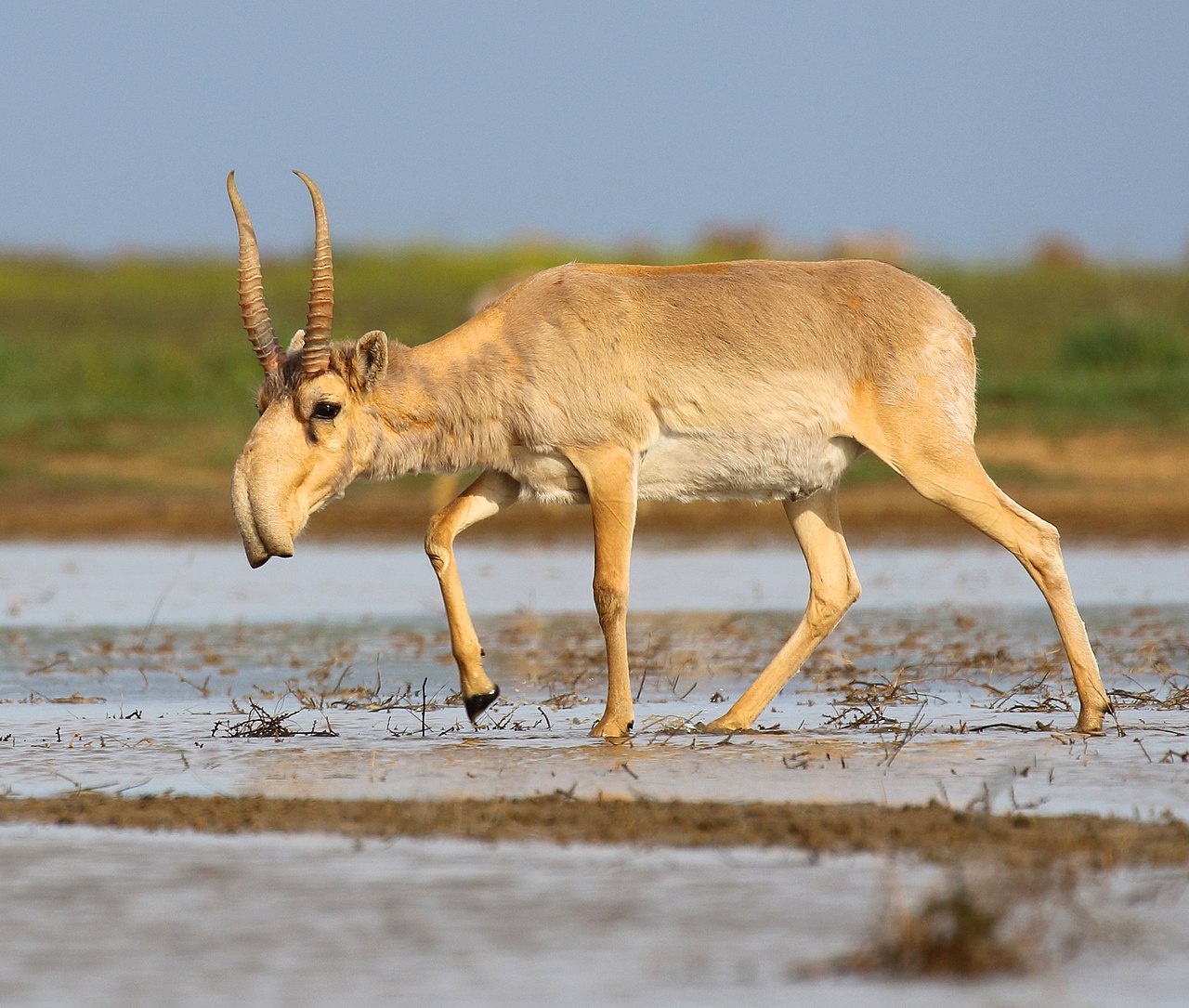
Two decades ago, the saiga antelope was staring down extinction. Ravaged by poaching and habitat loss after the fall of the Soviet Union, the bizarre-nosed antelope of the Central Asian steppe had dwindled to roughly 39,000 individuals by the early 2000s. Today, that number has surged past 1.9 million — a nearly 50-fold increase that ranks among the most extraordinary wildlife recoveries in modern history.
The International Union for Conservation of Nature recently downlisted the saiga from Critically Endangered to Near Threatened, a formal recognition of the dramatic turnaround. The recovery has been so successful that Kazakhstan now grapples with a very different kind of problem: managing a booming population that sometimes comes into conflict with agricultural interests.
The Nose Knows
The saiga is one of the most visually distinctive animals on Earth. Its oversized, bulbous nose — an evolutionary adaptation that filters dust during summer migrations and warms freezing air in winter — gives it an almost alien appearance. Males sport amber, ridged horns that have historically made them a target for poaching, as the horns are prized in traditional medicine.
The species has survived since the Ice Age, once roaming alongside woolly mammoths across the Eurasian steppe. But the collapse of the Soviet Union in 1991 triggered an economic crisis that drove desperate poaching on an industrial scale. By 2003, only about 21,000 saiga remained in Kazakhstan.
What Turned Things Around
The recovery is the result of sustained, coordinated conservation over two decades. Kazakhstan implemented strict anti-poaching patrols, established protected calving areas, and worked with international organizations including the Convention on Migratory Species and the World Wildlife Fund.
Local communities became partners rather than adversaries. Rangers from steppe villages were hired to patrol saiga habitat, creating economic incentives for protection. Cross-border cooperation with Russia, Mongolia, and Uzbekistan — which host smaller saiga populations — strengthened protections across the species' range.
Surviving Catastrophe
The road to recovery was far from smooth. In 2015, a catastrophic die-off killed more than 200,000 saiga — over 60 percent of the global population at the time — in just weeks. The cause was a bacterial infection triggered by unusual weather conditions, and for a moment it seemed decades of conservation work might have been undone.
But the saiga proved resilient. Thanks to the habitat protections and anti-poaching measures already in place, the population bounced back faster than anyone expected. Within just a few years, numbers had not only recovered but surpassed pre-die-off levels.
The saiga's story offers a powerful lesson: with sustained commitment, political will, and community involvement, even species on the very edge of extinction can make spectacular comebacks. It's a reason for hope in an era when conservation victories can feel rare.


