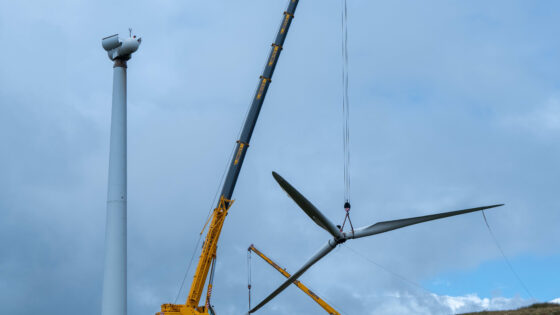
Scotland just dismantled its very first commercial wind farm — and almost none of it went to a landfill. An independent report on Hagshaw Hill found that 99.9% of the materials from its 26 retired turbines were recycled or reused.
- 99.9% of materials from 26 decommissioned turbines recycled or reused
- 79.5% recycled outright, 20.4% reused directly
- 30 years Hagshaw Hill operated before being repowered
- 10+ supply chain companies given contracts, most within 30 miles of the site
From landfill fears to a circular economy
Hagshaw Hill, in South Lanarkshire, went online in 1995 as Scotland's first commercial wind farm: 26 turbines generating 15.6 megawatts. A further 20 turbines were added in 2008. After roughly 30 years of operation, the original 26 machines were retired in 2023 to make way for 14 newer, larger turbines that lifted the site's capacity to 80 megawatts, according to New Civil Engineer.
That "repowering" cycle is where wind energy critics often raise a familiar objection: turbine blades, built from fiberglass composite, are notoriously hard to recycle and have historically ended up buried. Hagshaw Hill's decommissioning was built specifically to test whether that had to be true anymore.
Where the old turbines actually went
Engineering consultancy Mott MacDonald reviewed project data and interviewed stakeholders for ScottishPower Renewables, the utility that owns the site, to independently verify the outcome. The audit found 79.5% of turbine materials were recycled and another 20.4% reused — components like gearboxes, hubs, and steel towers finding second lives rather than being scrapped.
"The decommissioning of Hagshaw has been a real flagship project as it proves we can commit wind power to being part of a circular economy... This is a great result for the project and demonstrates what is achievable with the support of the supply chain, the majority of which was within 30 miles of the site," said Ross Galbraith, ScottishPower Renewables' onshore construction and operations director, in comments reported by RenewEconomy.
The trickiest part — the composite blades — went to Plaswire, a Northern Ireland-based recycler that grinds them into a polymer used in place of concrete, timber, or virgin plastic for fencing, marker posts, and drainage products. Other turbine parts are being repurposed as training aids for technicians entering the wind-decommissioning industry.
Why this result matters beyond one Scottish hillside
Mott MacDonald's decarbonization lead, Mark Crouch, said the report gives the wider industry something concrete to point to. "The energy sector and companies in the supply chain can invest with confidence when they can see windfarms being approved for repowering," he said, noting it could mean sustained jobs "for years to come as the first windfarms make way for the next generation."
Thousands of the UK's earliest turbines, installed in the 1990s and 2000s, are approaching the same end-of-life decision Hagshaw Hill faced. Plaswire's CEO, Andrew Billingsley, said his company has now won approval to process blades from outside the UK too, opening "a massive European and international market."
Some components didn't need recycling at all. Several of the retired nacelles and gearboxes are being kept intact and repurposed as hands-on training aids for technicians entering the wind-decommissioning trade — a small but telling sign that an entire industry is forming around what to do with a wind turbine's second life. Hagshaw Hill's numbers won't be identical at every site, but they're the clearest proof yet that wind power's waste problem has a practical, already-working answer.