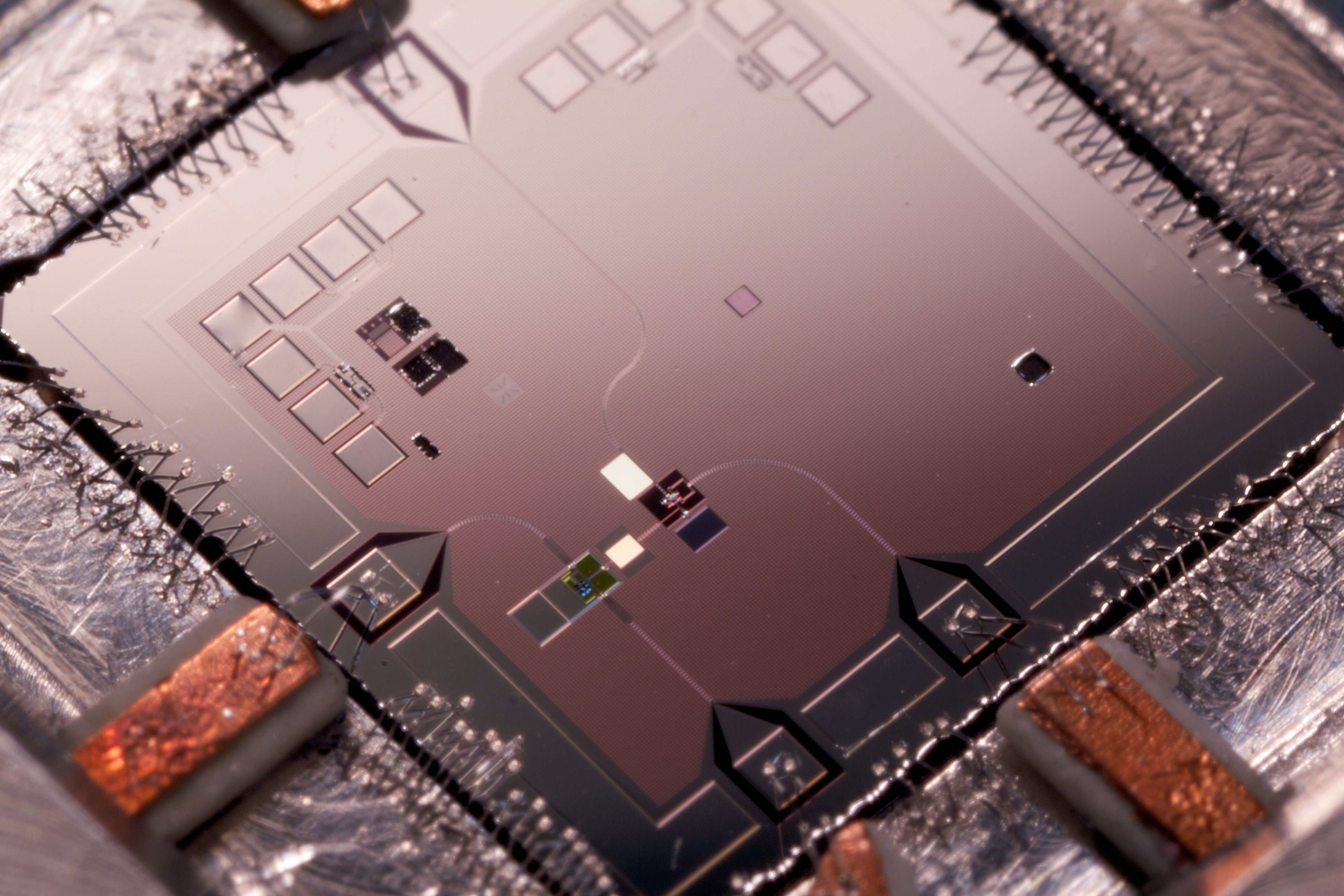
For the first time ever, physicists have watched a single unit of sound disappear from one energy state and reappear in another — live, in real time, inside a chip smaller than a fingernail.
- 2 milliseconds — how long the microscopic resonator can keep "ringing" before its vibration fades
- 1986 — the year scientists first observed quantum jumps in trapped ions
- 2007 — the year the same feat was achieved with photons, the particles of light
- 100+ years — how long quantum jumps have been theorized, dating to the early 1900s
Why sound was the hardest target to catch
Photons and ions gave up their quantum secrets decades ago. Sound held out longer. A Stanford team led by physicist Amir Safavi-Naeini has now closed that gap, publishing the first direct, real-time observation of a quantum jump in a phonon — the smallest possible unit of sound — in the journal Science.
A phonon represents the coordinated vibration of a huge number of atoms acting together. Ring a bell, and to human ears the sound fades smoothly. At the quantum scale, the same vibration doesn't fade gradually at all — it drops in sudden, discrete steps, jumping from one energy level to the next, the same way electrons jump between orbits in an atom.
"What this study shows will allow us to move forward with developing new quantum technologies with sound," said Safavi-Naeini, associate professor of applied physics at Stanford. "We have seen that vibrating objects can exhibit quantum behavior, which is the prerequisite for many of the operations needed by quantum computing and sensing."
A microscopic tuning fork that rings for hours
The breakthrough hinged on a mechanical resonator, built with the same chip-fabrication tools used to make computer processors. It behaves like a microscopic tuning fork — except this one can keep vibrating for two full milliseconds. Scaled up to the size of a normal tuning fork, that same relative endurance would mean it kept ringing for several hours instead of fading in seconds.
That long "ringdown time" gave researchers, led by co-first authors Takuma Makihara and Erik Szakiel, enough time to take hundreds of measurements of a single resonator and catch the precise instant its energy state dropped from 1 to 0.
Getting a usable reading out without destroying the fragile quantum state was the real engineering puzzle. The team solved it by coupling the resonator to a superconducting qubit, an electrical circuit that doubled as a highly sensitive detector, checking the phonon's state over and over without collapsing it prematurely. "We had to continually develop new processes to make this extremely long-lived, vibrating object and then integrate it with the qubit... without ruining either subsystem," Makihara said.
Where sound-based quantum tech could go next
The advance points toward two concrete uses. First, error correction: in most quantum computing architectures, an unwanted quantum jump signals a computational error, and this technique gives researchers a new way to catch those errors as they happen, rather than after a calculation has already failed. Second, ultra-sensitive detection — Safavi-Naeini's lab is already working with Caltech physicist Michael Roukes' group to test whether the same resonator-qubit combination could detect individual proteins inside living cells.
There's an everyday-tech angle, too. Sound underpins the microphones and speakers in every smartphone, and finer control over how phonons behave could eventually filter down into consumer electronics, according to Stanford's own reporting on the study.
For now, the achievement is a purely scientific one: a hundred-year-old theoretical prediction, finally caught in the act, on a chip small enough to fit dozens across a single wafer.