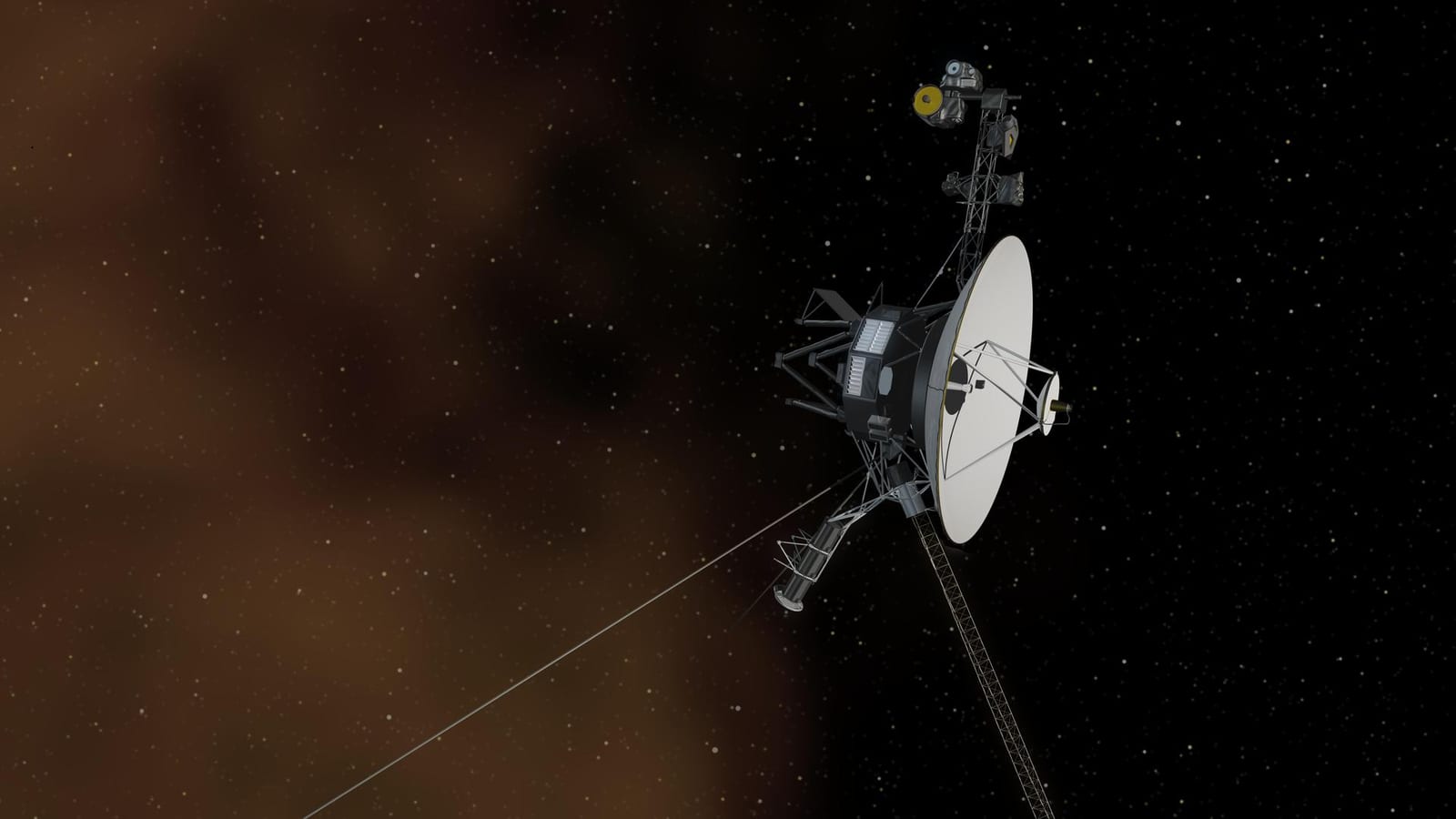
On Wednesday, a spacecraft launched before most of its own mission team was born will cross a distance so vast that light itself needs a full day to cover it.
- 16 billion+ miles (25.9 billion km) from Earth as of Nov. 18, 2026
- 1 light-day — the time it takes light, and radio signals, to make the trip
- 49 years since Voyager 1 launched on September 5, 1977
- 2012 the year Voyager 1 first crossed into interstellar space
The farthest thing humans have ever built
Voyager 1 is already the most distant human-made object in existence, and on November 18 it adds a new milestone: one full light-day from Earth. At that range, a radio command sent from NASA's Deep Space Network takes 24 hours just to arrive — and another day for a reply to come back.
The spacecraft left Earth in 1977 to take advantage of a rare alignment of the outer planets that happens roughly once every 176 years, letting it swing past Jupiter and Saturn using gravity assists instead of massive amounts of fuel. It entered interstellar space in 2012; its twin, Voyager 2, followed on a different trajectory in 2018. Both are still returning unique data from beyond the Sun's protective bubble, the heliosphere.
How NASA is marking the moment
Rather than let the milestone pass quietly, NASA is turning it into a global event. On Tuesday, November 17, the agency is inviting people everywhere to take part in "Shine Bright for Voyager's Light-Day" — flashing phone lights, flashlights, or building lights after sunset in a coordinated show meant to symbolically reach the spacecraft.
NASA built an online tool that makes a phone or tablet screen flash "VGR," Voyager's radio call sign, in Morse code, and is asking participants to share photos and videos tagged to @NASA.
Light leaving Earth on November 18 will take a full 24 hours just to catch up with a 49-year-old spacecraft moving away from us at more than 38,000 miles per hour.
The people who are still flying it
A day later, on Thursday, November 19, NASA's Jet Propulsion Laboratory in Southern California is holding a public discussion in the same von Kármán Auditorium where mission scientists once briefed reporters on Voyager's original "grand tour" of the outer planets.
The panel includes Nicky Fox, NASA's associate administrator for the Science Mission Directorate; Jonathan Lunine, JPL's chief scientist and a Caltech professor; Suzanne Dodd, Voyager's project manager; Linda Spilker, the mission's project scientist; Kareem Badaruddin, Voyager's mission manager; and Jamie Rankin, the mission's deputy project scientist at Princeton University. NASA is also previewing a documentary on the mission ahead of Voyager's 50th anniversary in 2027.
A mission that keeps outliving its own predictions
Voyager 1 and 2 were designed for a four-year planetary tour. Instead, nearly five decades later, they remain the only spacecraft gathering direct measurements of interstellar space — plasma, cosmic rays, and magnetic fields that no probe has sampled before.
Both spacecraft run on decaying plutonium power sources that lose a little capacity every year, and engineers have had to shut down instruments one by one to stretch the remaining power. Even so, mission managers expect at least some science data to keep coming back for several more years.
Crossing one light-day doesn't change anything about Voyager 1's trajectory or its science. But for a mission that has already outlasted most of the engineers who built it, hitting a distance marker this large is a reminder of just how far 1970s engineering — and nearly fifty years of careful management — can carry a machine that was never supposed to still be talking to us.


