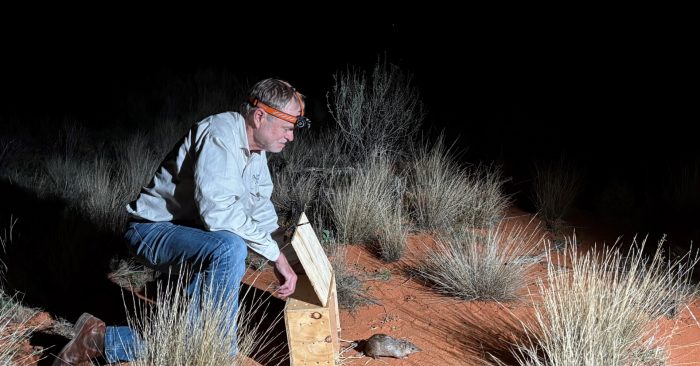
For more than a century, no bilby, bandicoot, or quoll walked free in outback New South Wales. Now hundreds do — and after a decade of work, they are finally raising young of their own beyond the fences meant to protect them.
- 6 locally extinct native mammal species reintroduced since 2016
- 4,000 hectares of rabbit-free exclosures — the largest in Australia
- 100 square-kilometre "wild training zone" where animals learn to dodge feral cats
- 10 more years of funding just locked in by the NSW government
A decade in the desert
The Wild Deserts project began in 2016 at Fort Grey, a former grazing property inside Sturt National Park. Ecologists Bec West and Reece Pedler moved there in 2017 to lead it, building roughly 50 kilometres of predator-proof fencing before a single animal could go back in.
Cats, foxes and rabbits had wiped out bilbies, bandicoots and burrowing bettongs from the region more than 100 years ago. "We've got the worst extinction record of any country in the world," says Wild Deserts team leader Professor Richard Kingsford.
Since the exclosures were declared feral-free in 2019, the team has released crest-tailed mulgaras, greater bilbies, Shark Bay bandicoots, golden bandicoots, burrowing bettongs and western quolls — six of the seven target species successfully re-established. Only the greater stick-nest rat failed to adapt.
Killer cats and a training ground
What sets Wild Deserts apart from ordinary predator-free sanctuaries is what happens next. Beyond the fenced exclosures sits a 100-square-kilometre "wild training zone" that deliberately keeps a low density of feral cats, letting released animals learn to survive real threats instead of staying permanently sheltered.
"We're seeing survival, we're seeing breeding, we're seeing new individuals joining that population that's living beyond the fence," West says. "All of those are really exciting indicators."
The reintroduced species are also "ecosystem engineers" — their digging turns over soil, traps seeds and water, and has visibly boosted plant growth compared with untouched ground nearby, according to ABC News reporting from the site.
"For me, as a conservation biologist, it's incredibly rewarding to be able to watch this restoration process unfold in front of my eyes." — Bec West, Wild Deserts principal ecologist
What's next
In June, NSW Environment Minister Penny Sharpe signed a new agreement guaranteeing another decade of funding, according to UNSW's newsroom announcement. "The return of locally extinct mammals to Sturt National Park shows what is possible when scientific expertise is combined with long-term commitment and strong partnerships," said UNSW Dean of Science Professor Sven Rogge.
The team now wants to push the model further afield. "I would like to start seeing how we might be able to return bilbies to other places where people are interested in seeing that sort of ecosystem restoration process," West says.
Above-average rainfall in recent years has helped, giving reintroduced animals more food and cover as their numbers grow both inside and outside the exclosures. Local pastoral families have also been folded into the project, releasing animals alongside the science team and watching the desert change around them.
"Undoubtedly there have been changes in the environment," says National Parks area manager Jaymie Norris, who has watched rarer plant species reappear across the landscape. "Literally at a landscape scale you can start to see the difference."
It is, in Kingsford's words, "tremendously exciting" — proof that one of the most degraded corners of the continent can still be coaxed back to life, one bandicoot at a time.


