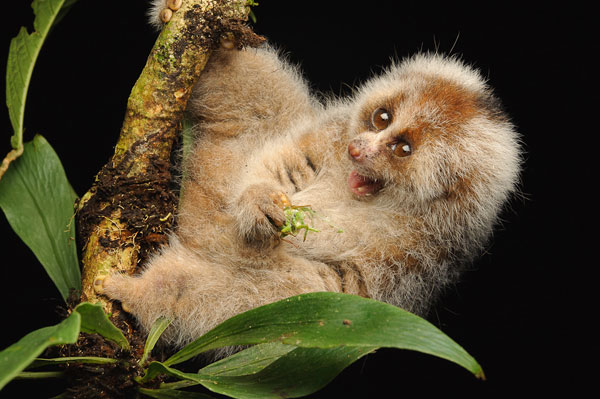
A fuzzy, venomous primate hasn't shown up in a scientific paper since 1937 — but it turns out Indonesian villagers have been quietly calling in sightings for a decade.
- 90+ Bangka slow lorises documented in the new study, 2015–2025
- 89 years since the species' last confirmed appearance in scientific literature
- 43 lorises rescued by one local NGO in 2021 alone
- 62% of the island's loris forest habitat lost between 2000 and 2012
A Primate Hiding in Plain Sight
The Bangka slow loris (Nycticebus bancanus) is native to Borneo and Indonesia's Bangka Island. It was listed as critically endangered, "possibly extinct," on the IUCN Red List in 2015, after scientists found no documented sightings for nearly a century.
But a new study, published in the journal Spixiana, tells a different story. Researchers analyzed more than 90 Bangka slow lorises rescued from backyards, roadsides, and plantations by the Alobi Wildlife Rescue Center, a local NGO that residents had been calling for help for years.
"What surprised me the most was that such a distinctive and fascinating primate could remain almost completely overlooked by science for nearly a century," said study co-author Timon Glaw, a graduate student at the Haus des Meeres Aqua Terra Zoo in Vienna.
What the Rescue Records Revealed
In 2021 alone, Alobi rescued 43 lorises, mapping 39 of them across all four districts of Bangka, including Pangkalpinang, the island's largest city. That spread indicates the species remains widely distributed — just never formally recorded.
The rescues also expose the hazards these animals face daily. That same year, seven lorises suffered electrical burns from power lines, while others were struck by vehicles, attacked by dogs, or caught in fences. At least three died from their injuries. Loris habitat on the island shrank by 62% between 2000 and 2012 alone, driven largely by illegal tin mining and oil palm expansion.
Despite the losses, there's a genuine recovery story here: 86 rescued lorises that healed were released back into protected forest fragments since 2015.
"Its natural habitat on Bangka Island has shrunk significantly because of illegal tin mining and massive land clearing for oil palm plantations," said Langka Sani, director of Alobi Wildlife Rescue Center, in a press release from Re:wild.
Why Bangka Island Matters Now
The study's authors are now recommending a formal IUCN reassessment to remove the "possibly extinct" tag altogether, alongside new habitat protections, post-release tracking, and a dedicated conservation breeding program.
Co-author Glaw sees the loris as a flagship for a wider ecosystem under pressure. "Protecting its remaining natural habitats, together with Bangka's threatened freshwater ecosystems, could help safeguard many other unique species that receive far less attention," he told Mongabay.
The species was one of Re:wild's "most wanted lost" primates — a list of animals unseen by scientists for years but suspected to still be clinging on. The Bangka slow loris is now one of the rare success stories to come off that list, not because anyone found something new, but because local rescuers' decade of quiet, unglamorous work finally reached the scientific record. The island's loris population survives in the gap between what gets published and what people on the ground already knew.