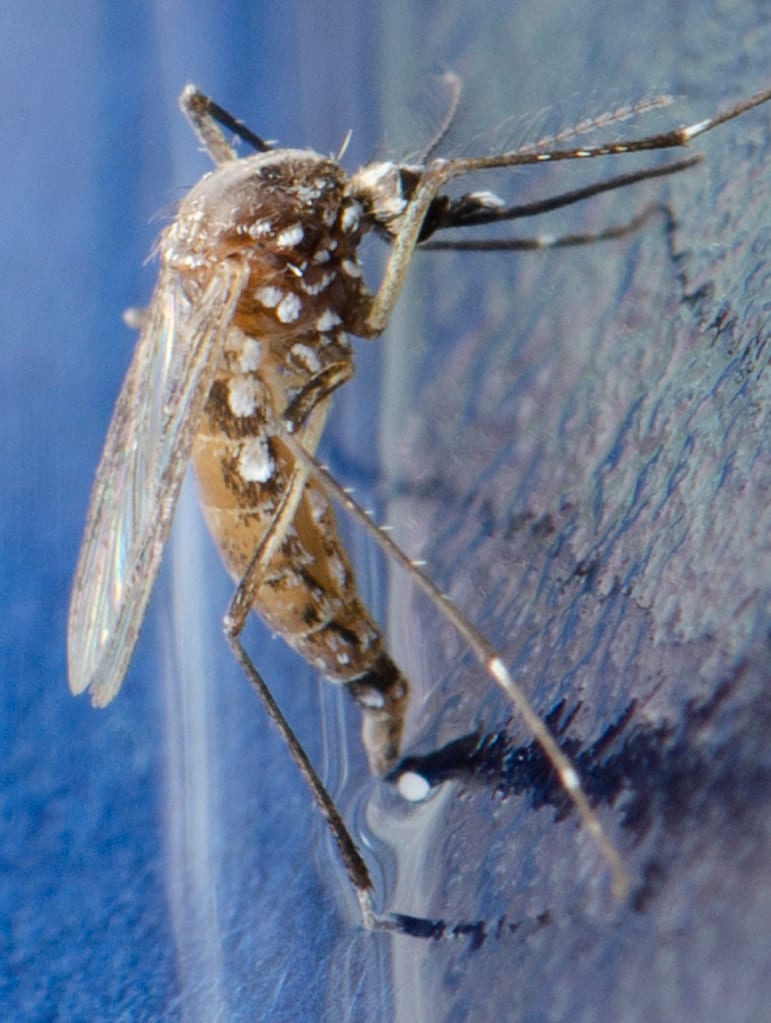
Counting mosquito eggs one by one under a microscope is the kind of job nobody wants — so researchers in Miami built an AI that can do it from a regular phone photo, catching 91.7% of the eggs actually present.
- 91.7% recall — the share of real eggs the AI correctly detected
- 88.3% precision — the share of flagged eggs that were genuinely eggs
- 4,398 individual eggs manually labeled to train the model
- 76 unseen field samples used to stress-test the tool against human experts
The problem the app was built to solve
Tracking disease-carrying mosquitoes like Aedes aegypti depends on a surprisingly low-tech tool: an ovitrap, a small cup of water with a paper strip that female mosquitoes are drawn to lay eggs on. Field teams collect the strips, then count the eggs under a microscope one at a time — a process that's slow, tedious, and prone to human error at scale.
Andre Costa-da-Silva, an assistant professor of biology at Florida International University's Biomolecular Sciences Institute, wanted to replace the microscope step with something every field worker already carries: a smartphone.
Building an AI that can actually count eggs
Costa-da-Silva's team trained their tool, called AeEggCounter, using the YOLO ("You Only Look Once") object-detection algorithm — the same category of AI used for real-time image recognition in other fields. To teach it what a mosquito egg looks like against a messy paper strip, researchers manually labeled 4,398 individual eggs across 168 smartphone photos.
"The idea was to develop this app based on a machine learning model," Costa-da-Silva said. "It's the first mosquito egg-counting tool capable of analyzing real-world field samples using images captured with different smartphone models."
That last part matters: most lab tools choke on inconsistent lighting, angles, and camera sensors from one phone to the next. AeEggCounter was built specifically to handle that mess.
How well it actually worked
In first-round testing, the tool hit 91.7% recall and 88.3% precision — strong numbers for a first-generation detector. The team then pushed it further, running the AI against 76 field samples it had never seen before and comparing its counts to trained human specialists.
"It doesn't replace the human," Costa-da-Silva said. "We still need humans to confirm the results, especially in sensitive areas where it's important to avoid mistakes."
Performance dipped slightly on the unfamiliar field samples compared to lab conditions, but the AI's counts still tracked closely with expert counts — enough to make it a credible first-pass screening tool rather than a replacement for careful lab work.
The research, a collaboration between FIU, the University of South Carolina, Boston University, and Baylor College of Medicine and Texas Children's Hospital, was published in the Journal of the American Mosquito Control Association.
From the lab to Miami backyards
The tool isn't staying in the lab. It's built into a free app called ACTT-Study, and FIU's Matthew DeGennaro, director of the Biomolecular Sciences Institute, is already using it in CDC-funded surveillance work in Miami's Little Havana and East Hialeah neighborhoods.
Students are testing it too. "Living in Miami was a great aspect to the class because we were able to actually set out ovicups at our homes to screen for eggs," said Melissa Gonzalez, a second-year biology student. "When we got back to class, we counted them both manually and with the app."
For public health departments juggling mosquito surveillance across entire counties, shaving hours off each egg count could mean faster warnings before an outbreak — turning a tedious lab chore into something a phone camera can help finish in minutes.