A single drop of coolant, deliberately boiled on contact, just cooled a simulated computer chip hotspot by 17°C in only 15 seconds — several times faster than the immersion cooling data centers already rely on.
The system comes from engineers at the University of Waterloo, who are trying to solve one of the most expensive problems in the AI boom: keeping power-hungry data center chips from overheating without burning through costly coolant.
- 17°C drop in simulated chip hotspot temperature
- 15 seconds for a single coolant drop to do the work
- Several times faster than standard immersion cooling alone
- Targets only the hotspots, not the whole chip surface
The problem with cooling AI chips
Data centers increasingly submerge chips and processors directly in specialized coolant, a technique called immersion cooling. It works well for steady, everyday heat, but AI workloads create a different challenge.
Depending on what a chip is processing, small areas can spike far hotter than the rest of the surface in a matter of seconds. Coolant that simply flows past the chip reacts too slowly, letting those hotspots linger long enough to slow the chip down, age it faster and undermine long-term reliability.
"It's a division of labour," said Dr. Sushanta Mitra, a professor of mechanical and mechatronics engineering and executive director of the Waterloo Institute for Nanotechnology. "Water is excellent at handling steady, everyday heat and the drops take care of sudden spikes."
How a single drop does the job
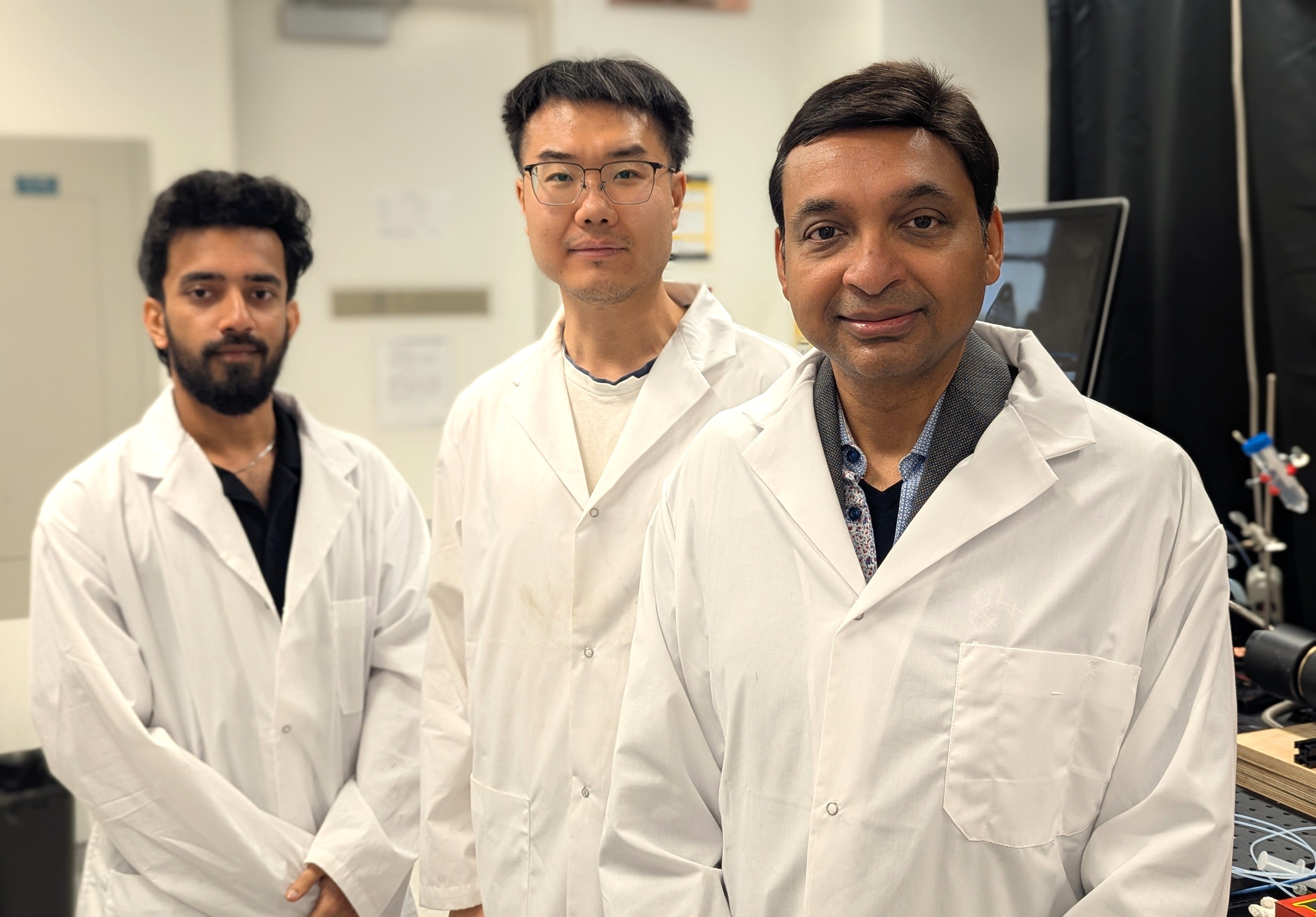
The research team, which also included postdoctoral researcher Dr. Tian-Yu Zhang and PhD student Arnav Banerjee, built on earlier work encapsulating one liquid inside a thin skin of another.
They chose an electronics coolant with a much lower boiling point than water, and heavier than water so it stays put on a hotspot instead of drifting away. In lab testing, that single drop boiled almost instantly once it touched a hotspot submerged in a water-filled tank.
"Boiling soaks up a lot of heat and the rising bubbles stir the surrounding water so it carries heat away faster," Mitra said. "We get the punch of boiling, but only where and when it's needed."
To control exactly how fast each drop boils, the team wrapped it in a thin skin of silicone oil mixed with tiny, heat-conducting ceramic particles. That coating acts like a dial, tuning the reaction so it releases its cooling power precisely on demand rather than all at once.
Where this could go next
The researchers envision two ways to deploy the system: coolant drops that continuously circulate through the main water bath and activate automatically whenever they hit a hotspot, or drops delivered on demand to locations flagged by onboard temperature sensors.
Because the approach is cheap, deionized water handling the bulk of everyday cooling and only small, targeted amounts of the pricier coolant used for spikes, it could cut the overall cost of cooling sprawling AI data centers without compromising performance.
The team also sees potential beyond servers. The same hybrid approach could help manage heat in electric vehicles, batteries, high-powered lasers and LED lighting, anywhere a system needs to survive sudden, localized bursts of heat rather than a steady load.
The study, published in the Journal of Colloid and Interface Science, lays out the physics behind the encapsulation technique in detail. Read the full University of Waterloo announcement here.
For an industry racing to build ever-denser AI hardware, shaving seconds off a hotspot's lifespan could matter more than it sounds — it's the difference between a chip that lasts years and one that degrades long before its time.