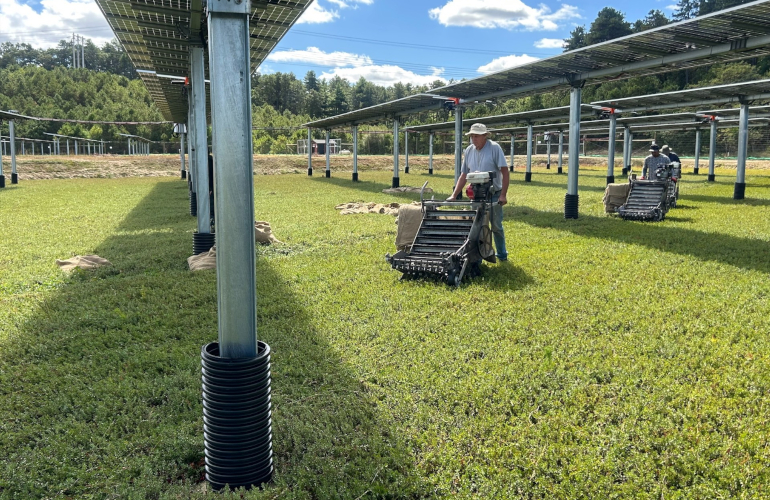
Two cranberry bogs that had sat empty and unprofitable for years are growing fruit again — underneath solar panels built directly over the wetland crop.
- 2 Massachusetts agrivoltaics projects: Black Cat (Plymouth) and Ring Road (Kingston)
- 1 MW solar capacity at Black Cat, paired with a 2.7 MWh battery
- 4.4 MW solar capacity at Ring Road, paired with a 13.5 MWh battery
- 2018 — the year Massachusetts became the first US state to offer extra incentives for dual-use solar
Growing crops and electricity on the same acre
The Black Cat Agrivoltaics Project in Plymouth and the Ring Road Agrivoltaics Project in Kingston are owned by developer Greenbacker Renewables and were installed by Distributed Energy Infrastructure (DEI). Both recently produced their first cranberry harvests since the solar arrays went up.
Before the installations, the bogs had become financially unviable and lay fallow for years. The solar projects now pay the landowner for leasing the land, which — combined with Iain Ward's income from managing the crop and selling cranberries — makes active cultivation worthwhile again.
Building solar over a working wetland crop is not straightforward. Panels had to be elevated and spaced to avoid disrupting water flow, flooding cycles, and the delicate root systems cranberries depend on.
"The DEI team was phenomenal at understanding and adapting solar construction so that energy production could coexist without damage to the perennial cropping system," said Iain Ward, the farmer who manages the bogs. "If we can build over such challenging wetland areas and have successful harvests, we can build almost anywhere."
Why the engineering mattered
Prateek Tare, EVP and co-founder of DEI, said the two projects tested the limits of where dual-use solar — known as agrivoltaics — can go. "Building solar projects over active perennial wetland crops was an exciting challenge, and we're thrilled to see the success of these harvests," Tare said. "Iain's collaboration and input at every stage was essential for us to ensure a reliable, cost-effective build while safeguarding the productivity of these heritage bogs."
Both projects were finalists for the North American Agrivoltaics Awards, and Ward and DEI are founding members of the Solar & Farming Association (SAFA), a coalition representing developers, farmers, and livestock producers working on shared-use solar land.
Canary Media reports that Massachusetts has pushed this kind of dual-use solar since 2018, when it became the first state to offer extra financial incentives specifically for projects that keep farmland in active production underneath panels rather than converting it entirely to energy infrastructure.
A model for marginal farmland
Cranberry bogs are a particularly demanding test case for agrivoltaics because they are wetlands, not standard dry cropland — meaning standard racking and foundation designs don't automatically transfer. The battery systems paired with each project (2.7 MWh at Black Cat, 13.5 MWh at Ring Road) also let the sites store power for grid use beyond daylight hours, adding a second revenue stream alongside the harvest.
For a crop whose economics have grown shakier for small growers in recent years, pairing it with solar lease income offers a path to keep land in cultivation rather than losing it to development or abandonment entirely. If bogs can host solar successfully, project backers argue, the same approach could extend to other marginal or wetland farmland that developers have historically avoided — turning land once considered too difficult to use into a source of both food and power.