Light moves fast. Getting it to change direction on command, just as fast, has always been the hard part — until now.
- 74 femtoseconds to redirect a beam of light
- 74 quadrillionths of a second — about the time light crosses a human hair
- 13 degrees, the steering angle achieved in the experiment
- Published June 22 in Nature Nanotechnology
Why Steering Light Is So Hard
Photonic technology — using light instead of electricity to carry information — promises faster communications, more powerful computing, and more sensitive sensors. But light is only useful if engineers can control where it goes, and most existing methods are slow.
Liquid-crystal panels and telecom optical chips typically redirect light by changing a material's electronic properties: exciting electrons to higher energy states, then waiting for them to relax back down. That relaxation process caps modulation speeds at nanoseconds or picoseconds — trillionths of a second, which sounds fast until you need something faster.
Caltech researchers led by Harry Atwater, the Otis Booth Leadership Chair of Caltech's Division of Engineering and Applied Science, set out to beat that limit entirely by not using electricity at all.
Light Steering Light
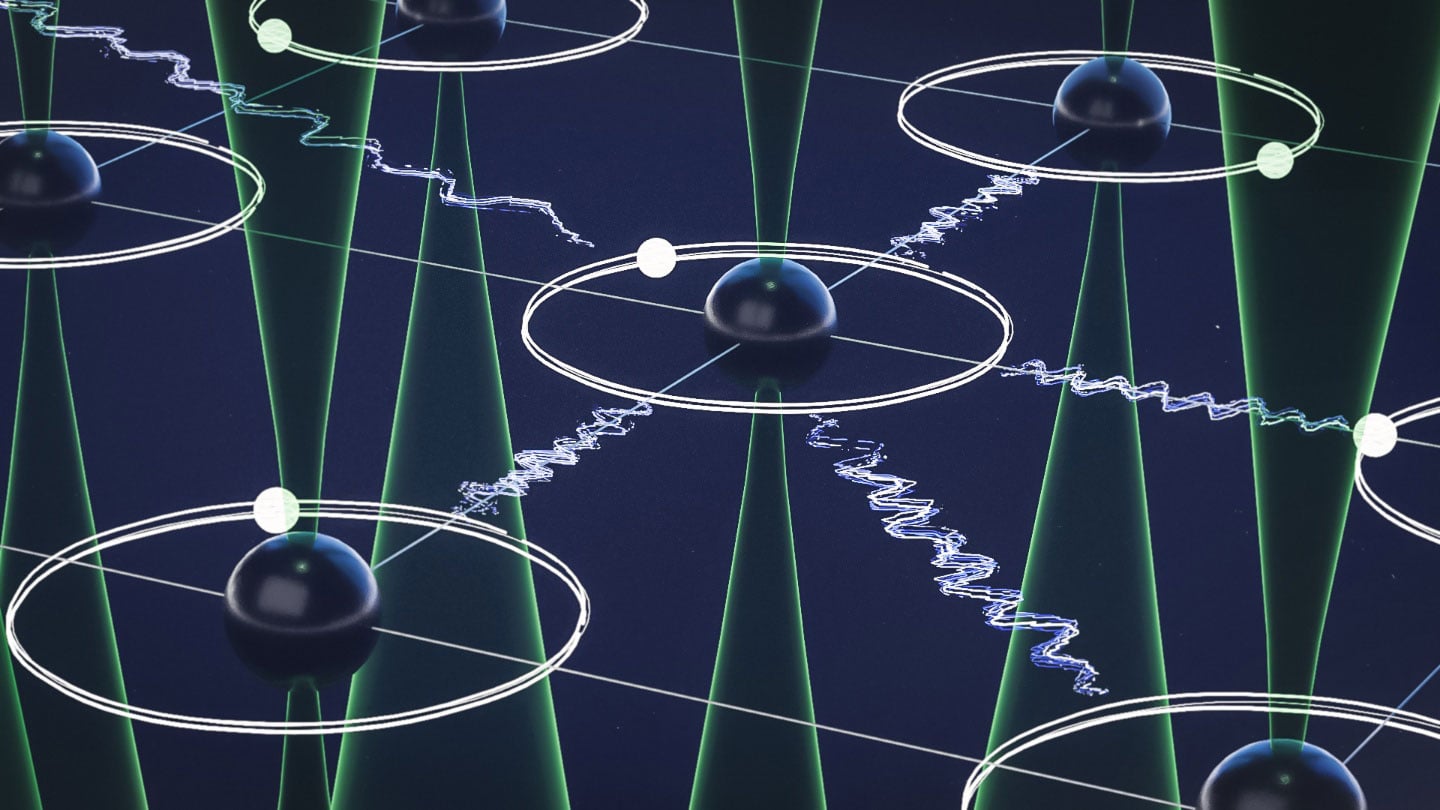
The team's device uses one intense beam of light, the "pump," to briefly reshape the optical properties of a target material. A second, weaker beam, the "probe," then passes through that material and bends according to the pump's pattern — a phenomenon called the optical Kerr effect.
Because the Kerr effect works by nudging electrons within their existing orbitals rather than exciting them to new energy states, the effect appears and disappears almost as fast as the light pulse itself. There's no waiting for anything to relax.
The catch: the Kerr effect alone is too weak to redirect a beam meaningfully. To amplify it, the researchers patterned a thin film of amorphous silicon into a meta-surface covered in nanoscale pillars, each smaller than the pump beam's wavelength. The pillars make light linger and recirculate briefly within the surface, magnifying a tiny refractive-index change into a signal strong enough to actually steer a beam.
"Steering light with light is very challenging because light typically interacts very weakly with matter," said Atwater. "Using optical meta-surfaces, we can up the interaction strength to make this possible with much higher efficiency."
What 74 Femtoseconds Unlocks
Using this approach, described in a paper in Nature Nanotechnology, the team steered beams at angles up to 13 degrees in just 74 femtoseconds — a speed currently limited by the duration of the laser pulse driving the system rather than by any property of the silicon itself.
That distinction matters. It means the 74-femtosecond figure is a floor, not a ceiling. With shorter laser pulses, the researchers expect the modulation speed to improve further, potentially approaching exotic photonic concepts like time crystals and synthetic time-varying materials.
The paper's lead author, Claudio Hail, completed the work as a postdoctoral scholar in Atwater's lab and is now an assistant professor of mechanical engineering at UC Berkeley. Co-author Lior Michaeli has since become an assistant professor at Tel Aviv University. The work was supported by the Air Force Office of Scientific Research, the Swiss National Science Foundation, a Fulbright Fellowship, and the Breakthrough Foundation, with infrastructure from Caltech's Kavli Nanoscience Institute.
For now, the result is a laboratory demonstration rather than a shipping product. But a light-steering method that sidesteps the electronic bottleneck entirely gives photonic engineers a genuinely new dial to turn — one measured in quadrillionths, not trillionths, of a second.