Physicists in the Netherlands just did something their own equations said should be impossible: they used radio waves to directly flip the magnetic spin hiding inside a single atom's nucleus.
- 1 single atom, imaged and controlled with a modified scanning tunneling microscope
- 2 independent radio signals applied at once — one to the electron, one to the nucleus
- 100 to 1,000x lower frequency needed to address a nuclear spin versus an electron spin
- Published in Nature Communications
The hidden magnet inside every atom
Every atom in a magnetic metal behaves like a tiny compass needle, and that magnetism comes from more than one source. Electrons carry most of it, but in some atoms the nucleus itself carries a faint magnetic spin too — one that's far weaker, but also far better shielded from outside interference.
"By far the strongest magnetism comes from the electrons," said lead researcher Sander Otte of Delft University of Technology. "But in some atoms, the nucleus also carries a spin. That spin is much weaker, but it is also much better shielded from the outside world." That shielding is exactly what makes nuclear spin so interesting to quantum researchers hunting for a stable way to store fragile quantum information.
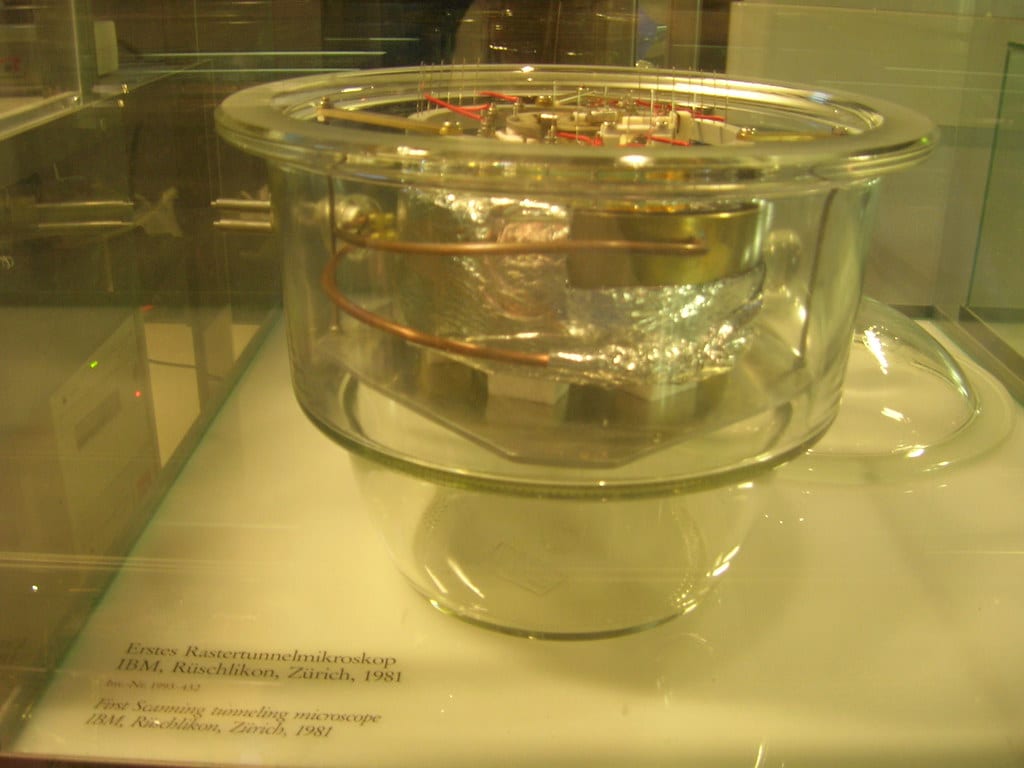
Otte's team uses a modified scanning tunneling microscope — an instrument that can deliver electrical signals to individual atoms with extraordinary precision — to study these effects up close.
An experiment that broke the rules
Lead author Hester Vennema and colleagues applied two separate radio signals to a single atom at once: one tuned to the electron's spin, one tuned to the nucleus's. The goal was simply to study the two independently. What happened instead caught the whole team off guard.
Even when the electron and nuclear spins were almost completely disentangled from each other, the nucleus still flipped its orientation in response to the signal. By the team's own prior understanding of the physics, that response shouldn't have been detectable at all.
"According to our simple understanding, this should not really happen. The nuclear spin should not be sensitive at all to the electrical signals from a scanning tunneling microscope."
Vennema compared tuning the two signals to playing two different strings on a guitar: each spin rotation responds only to its own precise frequency, and nuclear spins respond to notes roughly a hundred to a thousand times lower than electron spins do. Getting both instruments to play in the same experiment, without interference, required adapting a technique called double magnetic resonance down to the scale of one atom.
Why this matters for quantum computers
Quantum computers store information in states that are notoriously fragile, and nuclear spins have long been an attractive candidate for quantum memory precisely because they're so well-isolated from environmental noise. The problem has always been finding a reliable way to write and read that information in the first place.
This result, covered in detail by ScienceDaily, doesn't hand researchers a working quantum memory — the mechanism behind the surprise flip still isn't understood. But it proves direct control is physically achievable, which is the harder half of the problem.
Otte's group at TU Delft says the next step is figuring out exactly why the interaction works at all. "Back to the drawing board, then," Otte said. "That is really how science works. There is always something new left to figure out."