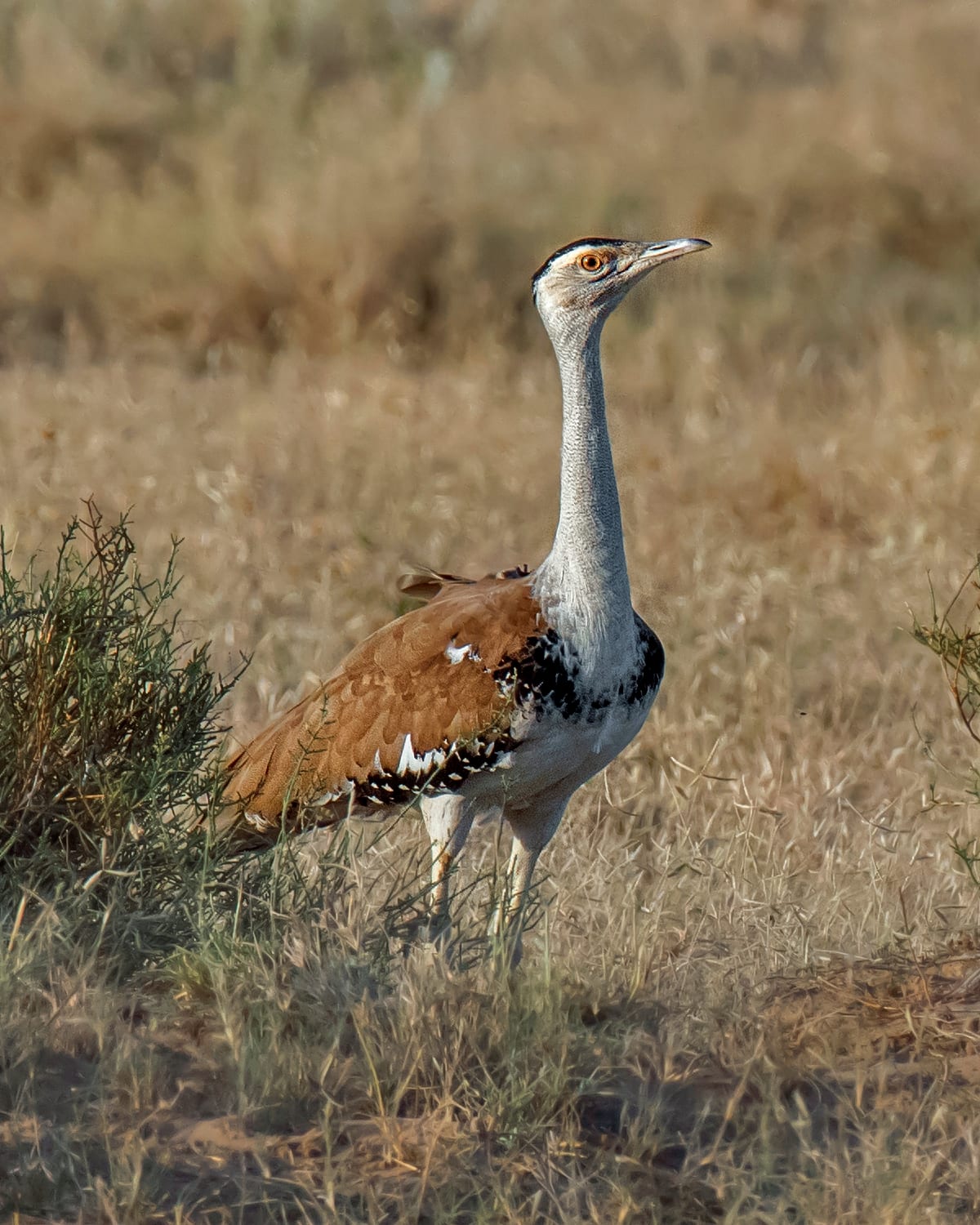
Ten captive-bred Great Indian Bustards walked free into the Rajasthan desert this fall — the largest single release yet in a seven-year effort to rebuild a bird species down to a population smaller than a typical school class.
- 10 captive-bred Great Indian Bustards released into Desert National Park in a single batch
- Fewer than 150 Great Indian Bustards remain in the wild worldwide
- 4 years of captive breeding at the Conservation Breeding Centre in Sam, Rajasthan
- 2 new chicks hatched at the breeding centre this year, growing the captive flock
A Bird That Nearly Vanished
The Great Indian Bustard once ranged across grasslands throughout India. Hunting, power-line collisions, and the steady loss of open desert habitat pushed the species to the edge, and the IUCN now lists it as critically endangered.
By the time conservationists intervened, the wild population had collapsed to a handful of scattered birds concentrated mostly in Rajasthan's Thar Desert. A single collision with a transmission wire can remove a meaningful fraction of the entire global population.
Project GIB, a partnership between the Wildlife Institute of India and the Rajasthan Forest Department, set out to reverse that trajectory. The team began collecting eggs from the wild in 2019 to start a captive-breeding line, betting that birds raised under human care could eventually repopulate the desert.
How Rajasthan Is Rebuilding a Flock
That bet is now paying off. The Conservation Breeding Centre at Sam, near Jaisalmer, has spent four breeding seasons incubating eggs, hand-rearing chicks, and preparing young bustards for life outdoors before they are ever set loose.
This year's hatching of two new chicks keeps that production line running. But the real test of the program is what happens after release, and October's batch of ten captive-bred birds into Desert National Park is the biggest vote of confidence the program has made so far.
Each bird released into the wild carries a tracking device, letting researchers follow how captive-raised bustards adapt to foraging, evading predators, and navigating a landscape full of human infrastructure that their wild-born ancestors never had to contend with.
Fewer than 150 Great Indian Bustards are believed to survive in the wild today, making every successfully released bird a measurable step toward recovery.
Why the Species Matters Beyond Its Numbers
The Great Indian Bustard is one of the heaviest flying birds on Earth, and it serves as an indicator species for the health of India's dry grasslands — ecosystems that get far less conservation attention than forests or wetlands but support their own distinct wildlife.
Rajasthan's state government has designated the bird its official state bird, and Desert National Park has become the focal point for nearly every major GIB recovery effort in the country. Officials have also begun work on undergrounding power lines near bustard habitat and installing bird diverters on transmission towers, tackling the collision risk that drove much of the species' original decline.
Conservationists caution that captive breeding alone will not save the Great Indian Bustard. Habitat protection, predator management, and continued public support in the surrounding villages all have to hold steady for releases like this one to translate into a self-sustaining wild population.
Still, ten more bustards walking the Thar Desert is ten more reasons to believe the species has a future. The IUCN Red List will be watching the next population survey closely, and so will the researchers who have spent years coaxing this ancient species back from the brink, one hatched egg at a time.