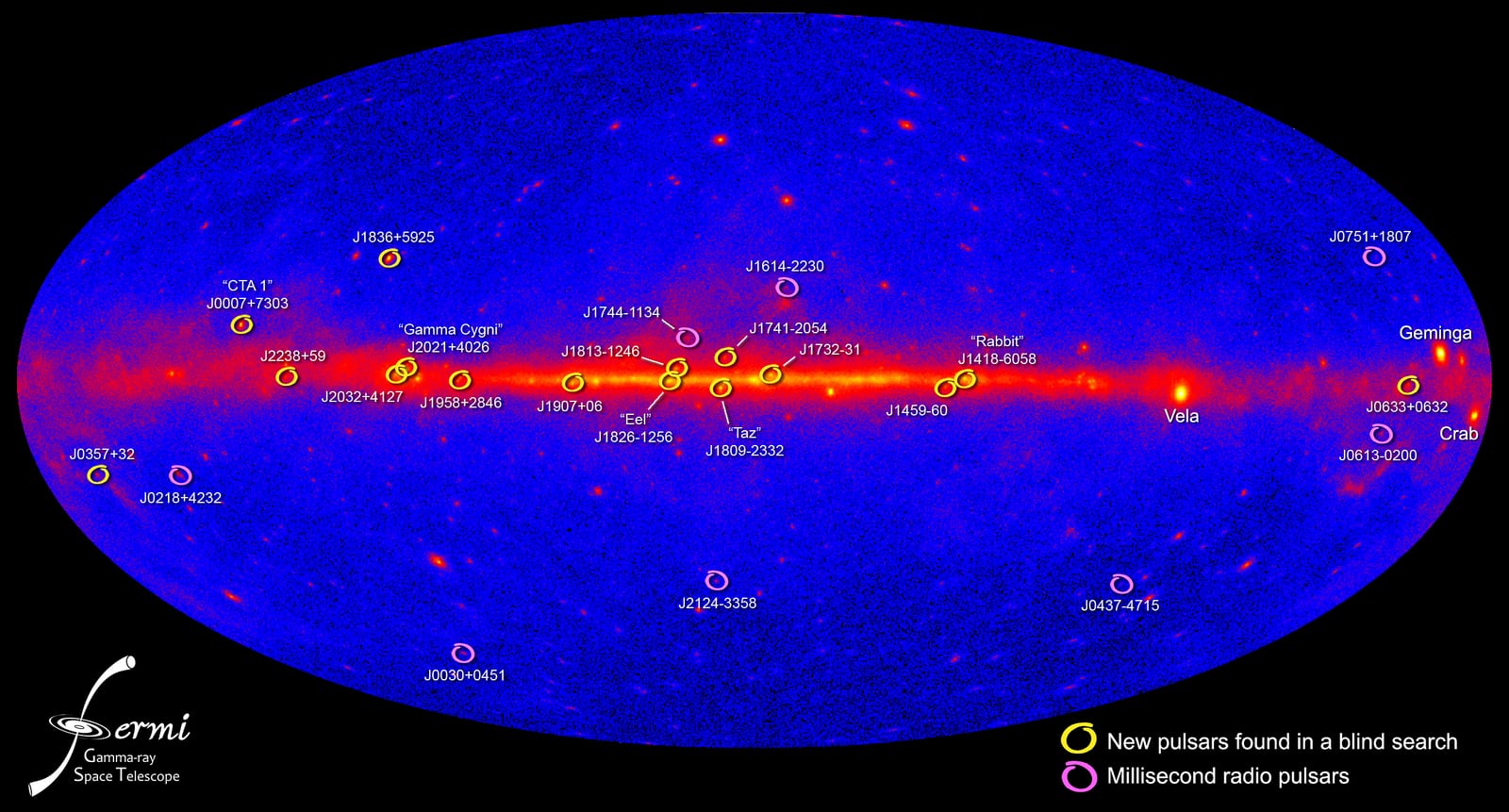
An international team just found a spinning neutron star that every previous search method had missed — and they did it with roughly 10 hours of computing time on an ordinary processor.
- 261 rotations per second — the spin rate of the newly confirmed pulsar, PSR J1622−7204
- ~1,000,000x faster than the previous best search method, by the team's estimate
- 600 years of standard-processor computing time the old method would have needed to even attempt the search — and it still failed
- 15 years of public NASA Fermi telescope data searched to find it
A Problem Too Big for Brute Force
Pulsars are rapidly spinning neutron stars that sweep beams of radiation past Earth like a cosmic lighthouse. Finding them in gamma-ray data from NASA's Fermi Gamma-ray Space Telescope is notoriously hard: Fermi detects only a handful of photons from any single pulsar, buried in noise from the rest of the universe.
To identify one, researchers must simultaneously guess the star's spin rate, how fast that spin is slowing, and its exact position in the sky — a search space so large that checking every combination was considered computationally impossible.
"We have a four-dimensional grid, and we must search each direction with millions of trials in it," said Daniel Pook-Kolb, a scientist at the Max Planck Institute for Gravitational Physics and lead author of the study. "There's just not enough computing power on Earth to do it."
Borrowing a Trick From Cryptography
The breakthrough came from reframing the search as a geometry problem. Study co-authors Dotan Gazith and Barak Zackay, of the Weizmann Institute of Science in Israel, realized the pulsar search could be solved using lattice-based algorithms originally developed by cryptographers — the same mathematics used to test encryption designed to resist future quantum computers.
"We have nothing to do with cryptography in our analysis here, but those algorithms can help us solve the problem of searching for pulsars in our data," Gazith said.
Applying the method to 15 years of Fermi data, the team identified PSR J1622−7204, an isolated pulsar spinning 261 times per second, using roughly 10 hours of computing time. The previous best technique had failed to find it at all — despite requiring enough computation that a single standard processor would need about 600 years to finish.
Why Open Data Made It Possible
None of this would have been possible without NASA's policy of releasing all Fermi data publicly. The mission has made its full 18-year dataset freely available since shortly after launching in 2008, letting researchers with no formal connection to the mission apply entirely new methods to it.
"The nice thing about NASA data is it's all open," said Colin Clark, an astrophysicist at the Max Planck Institute and study co-author. "All 18 years of Fermi data have been made public, and the data just keeps growing."
The results were published in Physical Review Letters on Thursday. The team's next target is even more ambitious: pulsars in binary star systems, where a companion star's gravity distorts the signal enough that such discoveries have long been considered out of reach.
Clark says the new algorithm, combined with crowdsourced computing power from volunteers in the Einstein@Home project, could soon turn up dozens more hidden pulsars already sitting in Fermi's archive, waiting to be found.