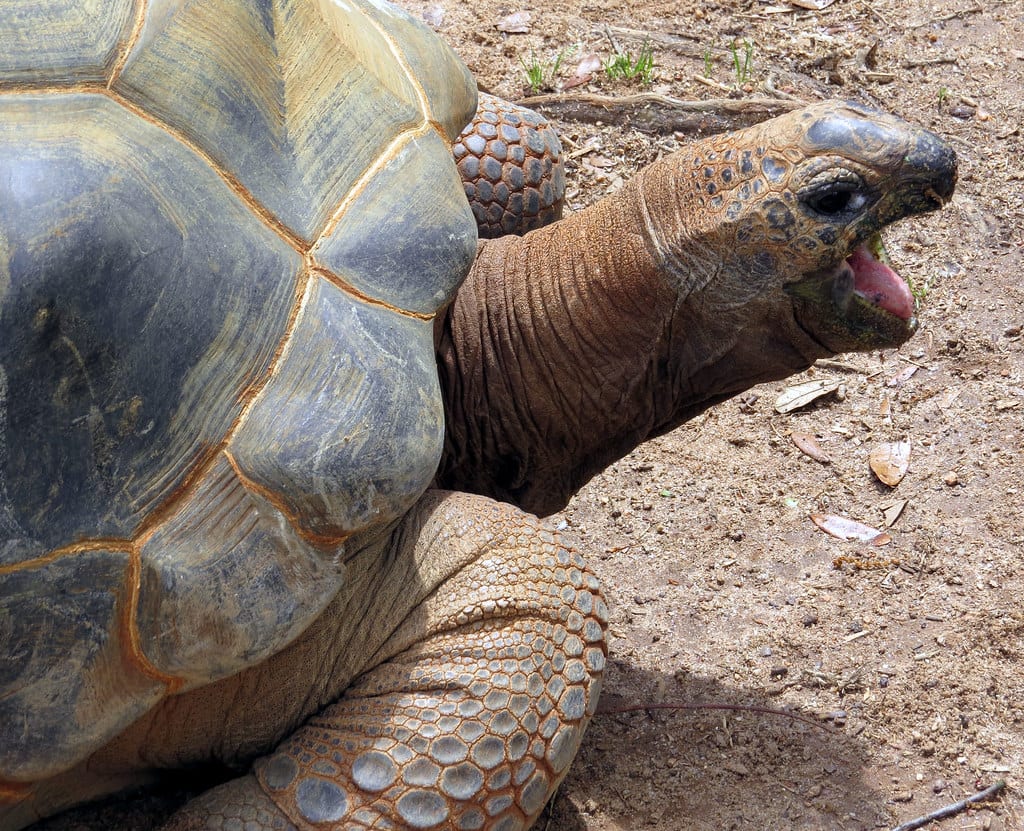
A tortoise hatched before photography existed just handed scientists a blueprint for healthy aging. Jonathan, a giant tortoise living on the South Atlantic island of St Helena, is confirmed as the world's oldest known living land animal at an estimated 194 years old — and researchers have now mapped why his body still works so well.
- 194 years is Jonathan's estimated age, making him the oldest known living land animal
- 287 distinctive genetic variants were identified in his epigenome
- 144 years is how long he's lived at his current home, Plantation House on St Helena
- This is the first-ever epigenome study conducted on a giant tortoise
A tortoise older than the lightbulb
Jonathan hatched around 1832, meaning he was already an adult when he arrived at Plantation House, the official residence of St Helena's governor, in the 1880s — after a journey from the Seychelles. He has outlived every human who has ever met him and witnessed roughly two centuries of human history from a single hillside paddock.
He's a member of the Aldabra giant tortoise species (Aldabrachelys gigantea), among the longest-lived land animals on Earth. But longevity alone doesn't explain how Jonathan has avoided the usual breakdowns of advanced age — cancer, organ failure, metabolic collapse — for this long.
What the genome revealed
Researchers at the nonprofit longevity research organization Kallel sequenced Jonathan's epigenome — the layer of chemical switches that turns genes on and off — and compared it to younger tortoises of the same species. They found 287 genetic variants tied to DNA repair, inflammation control, insulin regulation, and cancer suppression that have stayed remarkably stable throughout his long life.
The study, published in Science Advances, was led in part by Dr. Justin Gerlach of Peterhouse, University of Cambridge, who has studied giant tortoise ecology for decades but had never examined the biological mechanics of aging in the species before.
"We found that the gene regulators involved in energy production and DNA repair have remained incredibly stable in Jonathan over almost two centuries," Gerlach said.
Gerlach added that working with an animal this old reframed how his team approached the research entirely. "There are few creatures that could tell us more about aging than the giant tortoises of the Galapagos and Seychelles islands," he said. "You get a sense of the tortoise being your collaborator, not your study subject."
Why this matters beyond tortoises
Kallel founder Dr. Stephen Clark, the study's senior author, says the goal isn't just academic curiosity about reptiles — it's translating what evolution already solved into treatments humans can use.
"Nature has already solved the puzzle of aging in remarkable ways, and Jonathan's genome provides a blueprint for cellular resilience," Clark said. "Our goal is to take these evolutionary insights and immediately translate them into practical, affordable treatments for everyday people."
Aging remains the single biggest risk factor for most chronic disease in humans, from heart disease to dementia. Clark's team hopes that genetic pathways preserved in exceptionally long-lived species like Jonathan can point toward interventions that slow age-related decline in people, rather than simply treating diseases after they appear.
For now, Jonathan continues his routine on St Helena: grazing, basking, and occasionally greeting the island's visitors, blissfully unaware he's become a case study for the science of staying alive. His keepers describe him as still alert and active, if a little slower than when he arrived in the 1880s — which, given the math, seems entirely fair.