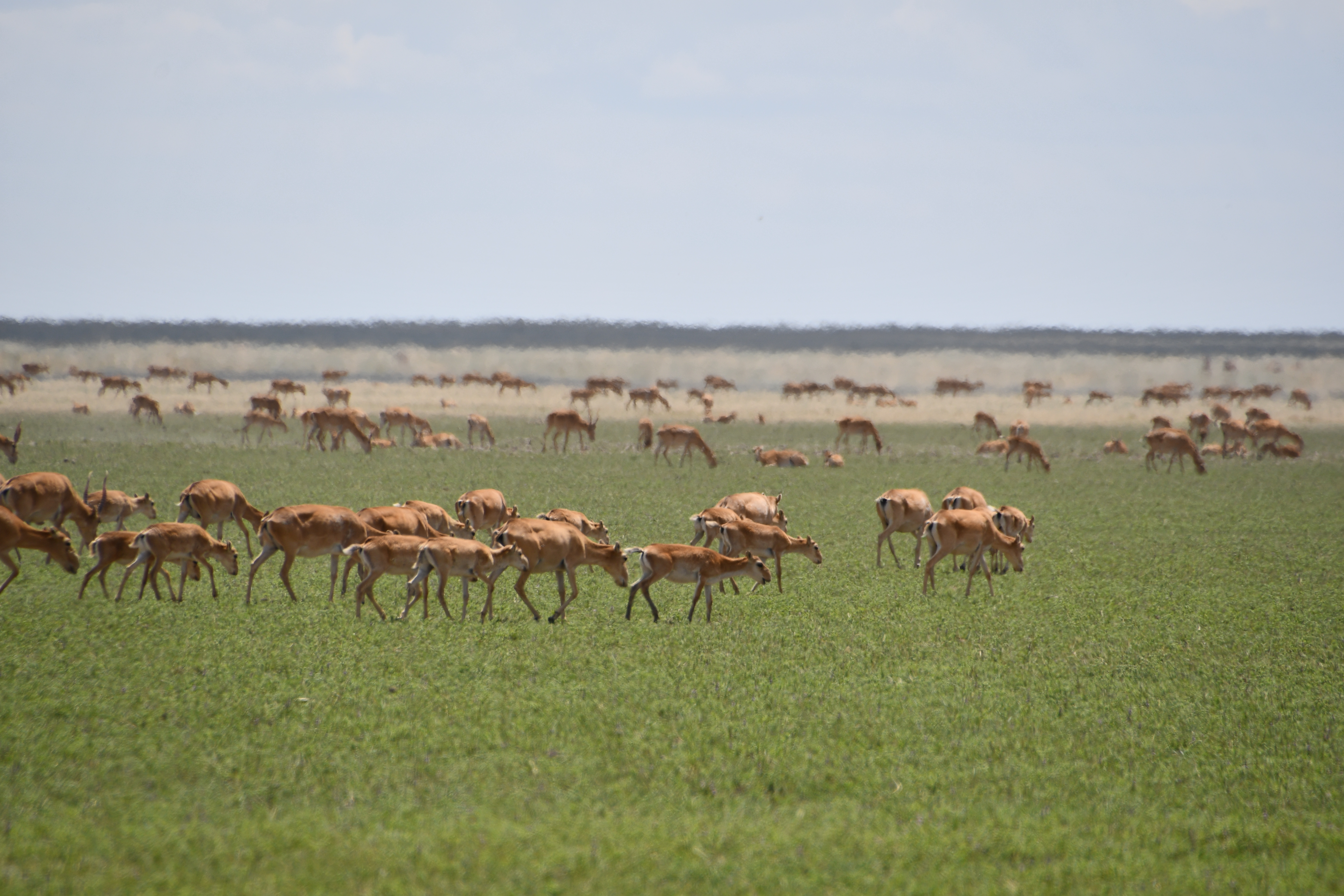
Twenty years ago, poachers had pushed Kazakhstan's saiga antelope to the edge of extinction. Today the herds number in the millions, and the world's last truly wild horse is walking free beside them again.
- 4.6 million saiga antelope in 2026, up from roughly 20,000 in the early 2000s
- 5 million hectares of steppe protected — an area larger than Denmark
- 5 Przewalski's horses released free in May 2026, the second consecutive annual release
- 100 kulan (wild asses) targeted for reestablishment on the Torgai steppe
How the saiga came back
The saiga is a small, migratory antelope known for its flexible, trunk-like nose, which filters dust and warms frigid air. After the Soviet Union collapsed, poaching for meat and for horns sold into traditional medicine markets crashed the population by more than 95% within a decade.
In 2006, five partners — Kazakhstan's Committee for Forestry and Wildlife, the Association for the Conservation of Biodiversity of Kazakhstan (ACBK), Fauna & Flora, the Frankfurt Zoological Society, and the RSPB — launched the Altyn Dala Conservation Initiative to reverse the decline. Altyn Dala means "golden steppe" in Kazakh.
Ranger teams and aerial patrols began covering the saiga's range, while satellite tags fitted since 2009 revealed exactly which migration corridors needed protection. The strategy survived its hardest test in 2015, when a bacterial outbreak killed more than 200,000 saiga, over 60% of the global population, within weeks.
Because poaching was already under control, the survivors rebuilt quickly. Annual aerial surveys counted 2.8 million saiga in 2024 and roughly 4.6 million in 2026 — about 230 times the low point. In December 2023, the IUCN Red List reclassified the species from Critically Endangered to Near Threatened.
"As one of the most successful recoveries of a terrestrial mammal ever recorded, this is a significant milestone for the saiga antelope conservation community and illustrates how conservation can be effective if all parties work together," said Vera Voronova, ACBK's executive director.
Bringing back the horses and wild asses
Saiga were never the only animals missing from the Golden Steppe. Kulan, a wild ass native to Central Asia, vanished from the Torgai steppe more than a century ago. Reintroductions began in 2017, with one group traveling 2,139 kilometers by road from Altyn-Emel National Park before release.
Przewalski's horses — the last horse species never domesticated — disappeared from Kazakhstan roughly 200 years ago and survived only in zoos worldwide. The first seven arrived at the Altyn Dala reserve in 2024. In late May 2026, five more horses, bred at Wildnispark Zürich and Hortobágy National Park, stepped out of their acclimatization pens and into the open steppe after a year of monitored adjustment to the harsh local climate.
Two of the released mares now carry satellite collars, letting biologists track how the group settles into the reserve's 40,000-square-kilometer network of protected corridors without disturbing them. Officials plan to bring 40 to 45 horses to the region by 2029 — enough, they hope, to sustain a self-sufficient herd.
What's left to do
The comeback has created new friction. Farmers in several regions report saiga damaging crops and competing with livestock for pasture, and authorities are now studying how to manage herd sizes without undoing two decades of work. Roads, railways, and fences still fragment migration routes.
Twenty years ago, the saiga seemed destined for the history books. Today millions roam the plains again, joined by wild asses and horses returning after a century or more of absence — proof that patient, well-funded, multi-decade conservation can still reverse what looked like a done deal.