Instead of feeding video through chips and circuits, a new deepfake detector feeds it through light itself. Engineers at UCLA built an optical-neural processor that screens more than a dozen videos simultaneously for AI-generated fakes, hitting 97.79% average accuracy while running almost entirely on passive optics.
- 97.79% average detection accuracy screening 15 videos at once
- 99.86% sensitivity — how reliably it catches an actual deepfake
- 18 video streams the system can analyze in a single optical pass
- 94.80% accuracy against videos made with Google's newer VEO-3 generator
Analyzing a dozen videos in one pass of light
Most deepfake detectors work the conventional way: a digital neural network crunches through frames one video at a time, a process that can take hundreds of billions of floating-point operations per clip. Professor Aydogan Ozcan's team, publishing in the journal eLight, took a different route entirely.
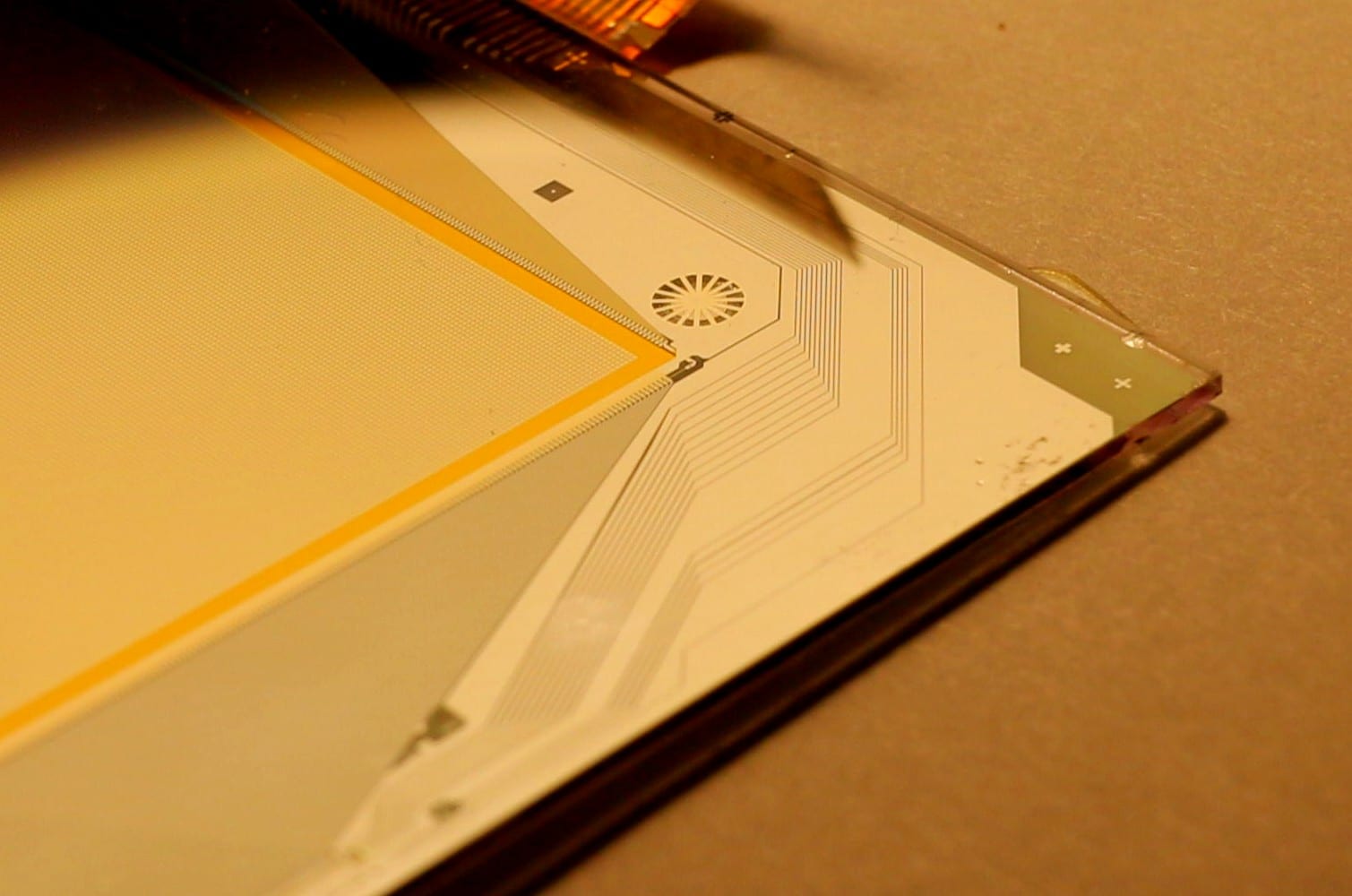
Their system uses a lightweight digital encoder to compress each video's spatial, spectral, and temporal fingerprints into a single phase pattern. That pattern is displayed on a programmable spatial light modulator, and an optical wavefront passes straight through a free-space optical decoder — no electricity required for the heavy lifting. Paired optical detectors on the other side read out an authenticity score for every video in the batch at once.
In testing against the Celeb-DF dataset, the system correctly flagged real and fake clips 97.79% of the time across 15 simultaneous video streams, with a false-negative rate of roughly 0.14%. Pushed to 18 simultaneous videos, accuracy held at 96.13%.
Catching the newest generation of fakes
Deepfake generators keep getting better at hiding their own artifacts, which usually means detectors trained on older fake videos start to fail against newer ones. Ozcan's team tested their optical system against videos made with Google's VEO-3, a far more advanced and harder-to-detect generator than the tools used to build most existing detection datasets.
The system held up at 94.80% accuracy and 97.61% sensitivity against VEO-3 footage, with only minimal retraining — evidence the optical approach generalizes rather than just memorizing one generator's quirks.
Adding two optimized passive diffractive layers to the decoder boosted accuracy by about 6.8% on the hardest, most heavily manipulated clips, without adding any energy cost, since the added layers are static optical structures rather than active electronics.
Harder to hack than a normal AI model
Because the system's "parameters" are physically baked into the shape and spacing of its optical components rather than stored as digital weights, it's inherently resistant to the kind of attacks that plague conventional AI. Reverse-engineering the model would mean physically reproducing its diffractive hardware, not just copying a file.
That matters because deepfake detectors are themselves a target: bad actors who know exactly how a detector thinks can sometimes craft fakes specifically designed to slip past it. An optical system that doesn't expose its decision logic as software is a much harder target to reverse-engineer or spoof.
The bigger pitch here is efficiency at scale. Platforms that need to screen millions of uploaded videos a day currently pay a steep computational and energy bill for digital deepfake detection. A system that screens over a dozen clips per optical pass, using light rather than heavy digital computation, points toward content moderation that scales without scaling its power draw — a meaningful advantage as AI-generated video becomes harder to tell from the real thing.