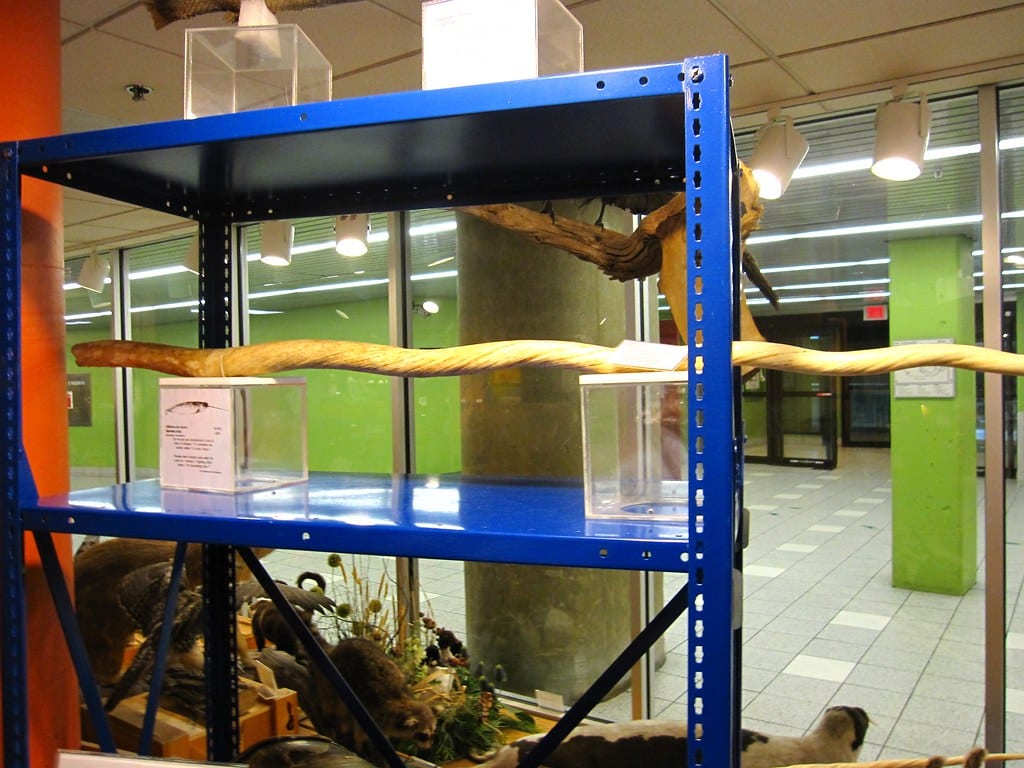
A male narwhal's spiral tusk can stretch 6.6 feet long, about half the length of its entire body, and scientists have finally worked out the hidden architecture that keeps it from snapping under decades of swimming stress.
- 6.6 feet (2 meters) — maximum length of a male narwhal's tusk
- 70 years — the age a tusk can keep growing throughout an animal's life
- 2 opposing spiral helices discovered woven inside the tooth
- 3 European synchrotron facilities used to scan its nanostructure
A 17th-Century Mystery, Solved
In the 1600s, Danish King Frederik III believed the spiraled tusks reaching his court were genuine unicorn horns. He sent an expedition to Greenland to track down their source, then had an entire throne built from them to project royal power across Europe. The "horns" turned out to be nothing mythical at all, just an overgrown canine tooth from an Arctic whale.
Unlike the gently curved tusks of elephants and walruses, a male narwhal grows a single forward-pointing tooth that twists counterclockwise as it pushes through the upper lip. Scientists still aren't fully sure what the tusk is for, though evidence points toward mate selection. Males have been filmed gently crossing tusks in what researchers call playful "duels."
Two Spirals Pulling in Opposite Directions
An international team led from Aarhus University in Denmark used a technique called tensor tomography to map a tusk's internal structure down to the nanometer scale. At first, the results made no sense at all: instead of the expected spiral, the scans showed only a flat, repeating pattern with no obvious twist.
The breakthrough came when researchers stopped studying individual measurement points in isolation and instead compared how neighboring points related to one another. "When we compared how these points were oriented relative to each other, a directional trend began to appear," said study lead author Adrian Rodriguez-Palomo. Connecting those trends revealed two intertwined helices — one in the tusk's outer cementum layer, one in its inner dentin — twisting in opposite directions like the strands of a rope.
Built Like Reinforced Concrete
That opposing-spiral design is what stops the tusk from twisting itself apart. Microscopic collagen fibers reinforce the tooth much the way steel rebar reinforces concrete, while mineral crystals supply raw hardness, together letting the structure resist both bending and torsion as the animal swims.
"The narwhal tusk, too, must be both hard and flexible. Only then can it withstand the strong hydrodynamic forces that swimming generates." — Marianne Liebi, Paul Scherrer Institute
The study, carried out with Aarhus University leading an interdisciplinary team and using beamtime at Sweden's MAX IV Laboratory alongside Swiss and French synchrotron facilities, was published in Nature Communications. It's part of a wider NordForsk-funded project tracking how narwhal tusks double as environmental archives.
As a tusk grows, it lays down yearly growth bands much like the rings of a tree, recording decades of Arctic sea ice, temperature and food availability. A single 70-year-old tooth, it turns out, now holds two secrets at once: a climate record written on the outside, and a feat of natural engineering built into its core.