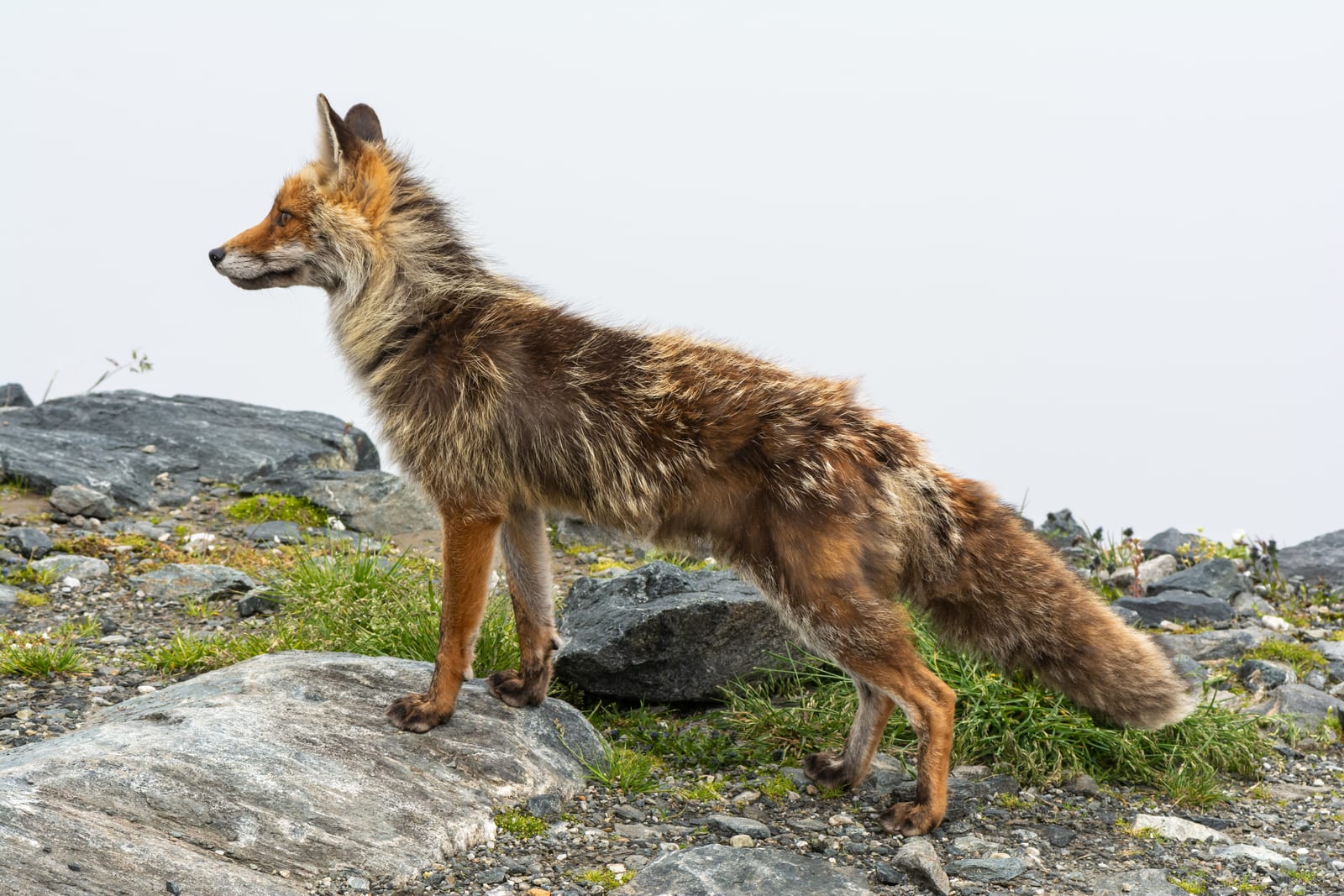
A hiker's phone camera caught something South Korea hadn't reliably seen in the wild for half a century: a calm, GPS-collared red fox sitting in the bushes, watching back.
- 110 red foxes now estimated living wild across South Korea
- 77 of those active in the Sobaeksan restoration zone alone
- 28 young foxes released into the wild in August 2026, 14 female and 14 male
- 14 years the reintroduction program has run, since 2012
A hiker's rare encounter
On November 15, a hiker known only as "A" was descending from the Eouigok Junction in Sobaeksan National Park when a red fox emerged from the bushes a few feet away. Rather than bolting immediately, the animal held the hiker's gaze for several seconds before slipping back into the mountains.
A GPS tracking collar around its neck told rangers the rest of the story: this was one of their own. The 110 red foxes the Korea National Park Service now estimates live wild nationwide are almost all descendants of a captive-breeding and release effort that has been running since 2012.
"I have climbed all 100 famous mountains and visited Sobaeksan six times, but this was the first time I had encountered such a precious guest," the hiker told Yonhap News TV. "I hope this brings good energy to many people."
How the comeback happened
Red foxes once ranged across the entire Korean Peninsula. Hunting, habitat loss, and a 1970s nationwide rat-poisoning campaign wiped them out almost entirely — foxes that ate poisoned rats died from secondary poisoning, and the species was declared a Class I endangered wildlife species.
The Korea National Park Service answered by building a breeding and release pipeline centered on Sobaeksan, chosen because it sits along the Baekdudaegan mountain corridor that lets foxes disperse naturally to new territory. Released foxes spend roughly eight months in an acclimation enclosure learning to hunt before rangers fit them with GPS collars and set them free, tracking their movements around the clock during the critical early weeks.
I hope this brings good energy to many people.
The agency's current target: 100 confirmed active foxes in the Sobaeksan zone by 2027, with at least five distinct populations that have bred successfully across three generations.
The threats that remain
Survival is still a coin flip for many released animals. Of the 259 foxes released since the program began, roughly 36% have died or been recovered within a year — mostly from roadkill, illegal traps, and pesticide poisoning. One male released at Sobaeksan in 2022 was later tracked as far away as Busan, a reminder of how widely the species ranges once it settles in.
Rangers continue sweeping release areas for illegal traps and running awareness campaigns for nearby residents, since the foxes increasingly have to cross roads and farmland as their range expands. The agency's advice to anyone who spots one, as reported by Asia Economy: keep your distance, don't feed it, and report injured or unusually behaving animals to the National Institute of Wildlife Conservation.
For now, the sighting is being taken as a good sign — proof that a 14-year restoration bet on one of the peninsula's lost predators is slowly paying off, one collared fox at a time.